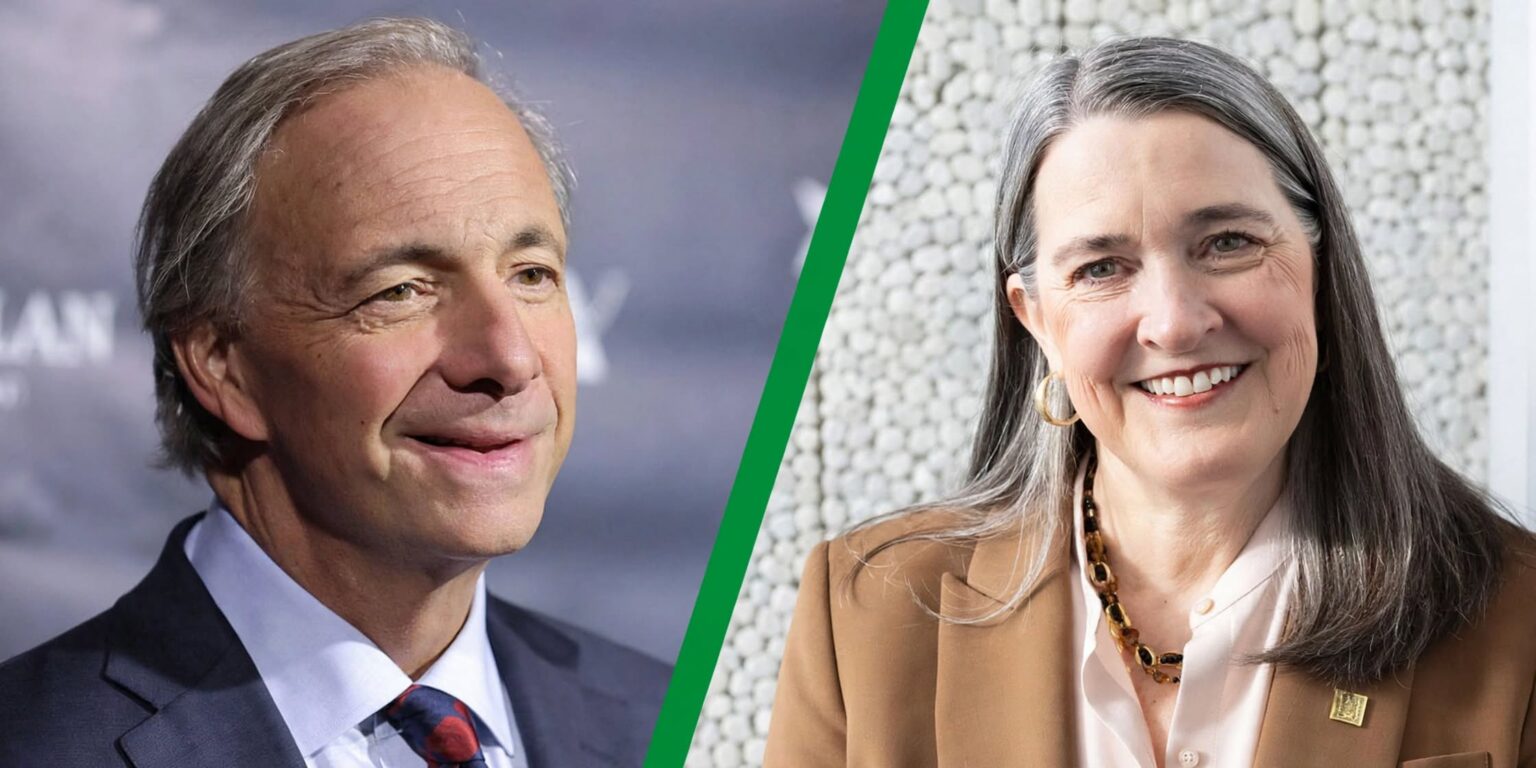

Ray Dalio and Patricia Poppe built their careers around different kinds of difficult decisions. Dalio founded Bridgewater Associates, developing an investment business concerned with markets, economic change, and financial risk. Poppe, widely known as Patti, became chief executive of PG&E Corporation after a career in manufacturing and energy. Their professional histories offer a useful comparison: how does someone build an organization that can recognize problems and respond to them? For Dalio, that question shaped investment research and workplace debate. For Poppe, it involves the daily work of supplying energy safely and earning customers’ trust. Bridgewater biography, PG&E biography.
Ray Dalio: Building a Business Around Economic Decisions
Dalio founded Bridgewater in 1975 from his New York City apartment. Its early work included advising companies on financial risks and publishing market commentary. The business subsequently moved into managing institutional investments, including a bond account for the World Bank’s pension fund in 1987. Bridgewater’s account of its early business.
His career became closely associated with global macro investing, which examines broad economic forces across markets. Understanding how growth, inflation, and monetary conditions affect investments is central to that approach. It requires looking beyond an individual company to the environment in which many businesses and assets operate. Bridgewater’s investment overview.
What the All Weather Strategy Tried to Solve
Bridgewater launched All Weather in 1996, initially for Dalio’s trust assets. Its underlying problem was straightforward: a portfolio can appear diversified while remaining heavily dependent on one economic outcome.
The strategy sought to balance exposure to different conditions, particularly surprises in economic growth and inflation. Its contribution was to put the sources of portfolio risk at the center of asset allocation. The objective was resilience across environments; the name should not be read as a promise that investments cannot lose money. Bridgewater’s All Weather history.
His Departure From Ownership
Dalio’s status as Bridgewater’s founder should be distinguished from its current management. He stepped down as CEO in 2017 and transferred control in 2022. In July 2025, Reuters documented the sale of his remaining ownership stake, completing another stage of the succession. Describing him as Bridgewater’s current owner would therefore be inaccurate. Reuters’ coverage of the sale.
Patricia Poppe: From Factory Operations to Utility Leadership
Poppe’s route to the executive office began with operational work. She spent 15 years at General Motors before moving to DTE Energy, where her roles included power plant director. She later led CMS Energy and its principal subsidiary, Consumers Energy, before becoming PG&E Corporation’s CEO on January 4, 2021. PG&E’s appointment announcement.
In a 2024 conversation at UC Berkeley’s Haas School of Business, Poppe explained that she had once aimed to become a plant manager. A supervisor encouraged her to consider a larger leadership role. Her account places practical assignments and experience with frontline teams at the center of her development as an executive. UC Berkeley Haas interview.
Taking Charge After Bankruptcy
Poppe arrived at PG&E roughly six months after it emerged from bankruptcy on July 1, 2020. The California Public Utilities Commission had approved its reorganization with conditions involving governance and oversight.
The regulatory challenges continued into her tenure. In April 2021, the commission placed PG&E in the first step of an enhanced enforcement process because of shortcomings in prioritizing vegetation clearance near its highest-risk power lines during 2020. That history gives necessary context to the company’s emphasis on safety and operational reform. CPUC’s bankruptcy and oversight record.
Turning Safety Priorities Into Physical Work
One major initiative under Poppe has been moving power lines underground in areas exposed to wildfire risk. In October 2025, PG&E announced that it had energized 1,000 miles of underground lines through the program launched in 2021. The company said those lines served customers in high fire-risk areas across 27 counties. PG&E’s undergrounding announcement.
That milestone measures completed infrastructure. Assessing the broader turnaround also requires attention to safety, reliable service, and reasonable customer rates—the responsibilities identified by California’s utility regulator. CPUC’s description of its regulatory role.
How Their Leadership Approaches Compare
Dalio’s published management philosophy encourages employees to challenge reasoning, discuss mistakes openly, and question people above them in the hierarchy. He also acknowledges that this approach can consume time and create tension. Its intended benefit is better judgment through disagreement, although stating a philosophy does not establish how consistently an organization follows it. Bridgewater’s original philosophy.
Poppe describes her approach as “leading with love,” alongside lean management practices learned in manufacturing. In her Berkeley discussion, she connected care for employees with making problems visible and helping people take responsibility for improvements. Her emphasis combines workplace relationships with attention to how everyday tasks are performed. UC Berkeley Haas interview.
Read together, these accounts suggest a shared emphasis on making problems visible. Their operating responsibilities create different tests of success.
| Point of comparison | Dalio’s investment work | Poppe’s utility leadership |
|---|---|---|
| Central decisions | How to understand markets and allocate investment risk | How to operate and improve energy infrastructure |
| Major uncertainty | Changing economic and market conditions | Wildfire exposure and infrastructure performance |
| Accountability | Investment results and client objectives | Safety, service reliability, and customer rates |
Frequently Asked Questions
Are Ray Dalio and Patricia Poppe business partners?
The sources reviewed for this article do not establish a direct business partnership between them.
Is Patricia Poppe the same person as Patti Poppe?
Yes. PG&E’s appointment announcement identifies its executive as Patricia K. “Patti” Poppe. Both names refer to the same person. PG&E appointment announcement.
What did Ray Dalio study?
Dalio earned a bachelor’s degree in finance from C.W. Post College in 1971 and an MBA from Harvard Business School in 1973. Publisher’s author biography.
Where did Patricia Poppe attend university?
Poppe holds bachelor’s and master’s degrees in industrial engineering from Purdue University and a master’s degree in management from Stanford’s Graduate School of Business. PG&E’s education summary.
Which Ray Dalio book explains his leadership ideas?
Principles: Life and Work, published in 2017, combines his personal history with ideas about decision-making, organizational culture, and learning from mistakes. Official publisher page.
Conclusion
Ray Dalio and Patricia Poppe offer two distinct case studies in business leadership. Their careers invite a practical question: what happens after an organization identifies a problem? Understanding their methods requires examining the decisions, responsibilities, and results that follow the management philosophy.
Read also Kobe Bryant and Lynn Good: Is There Any Real Connection?
