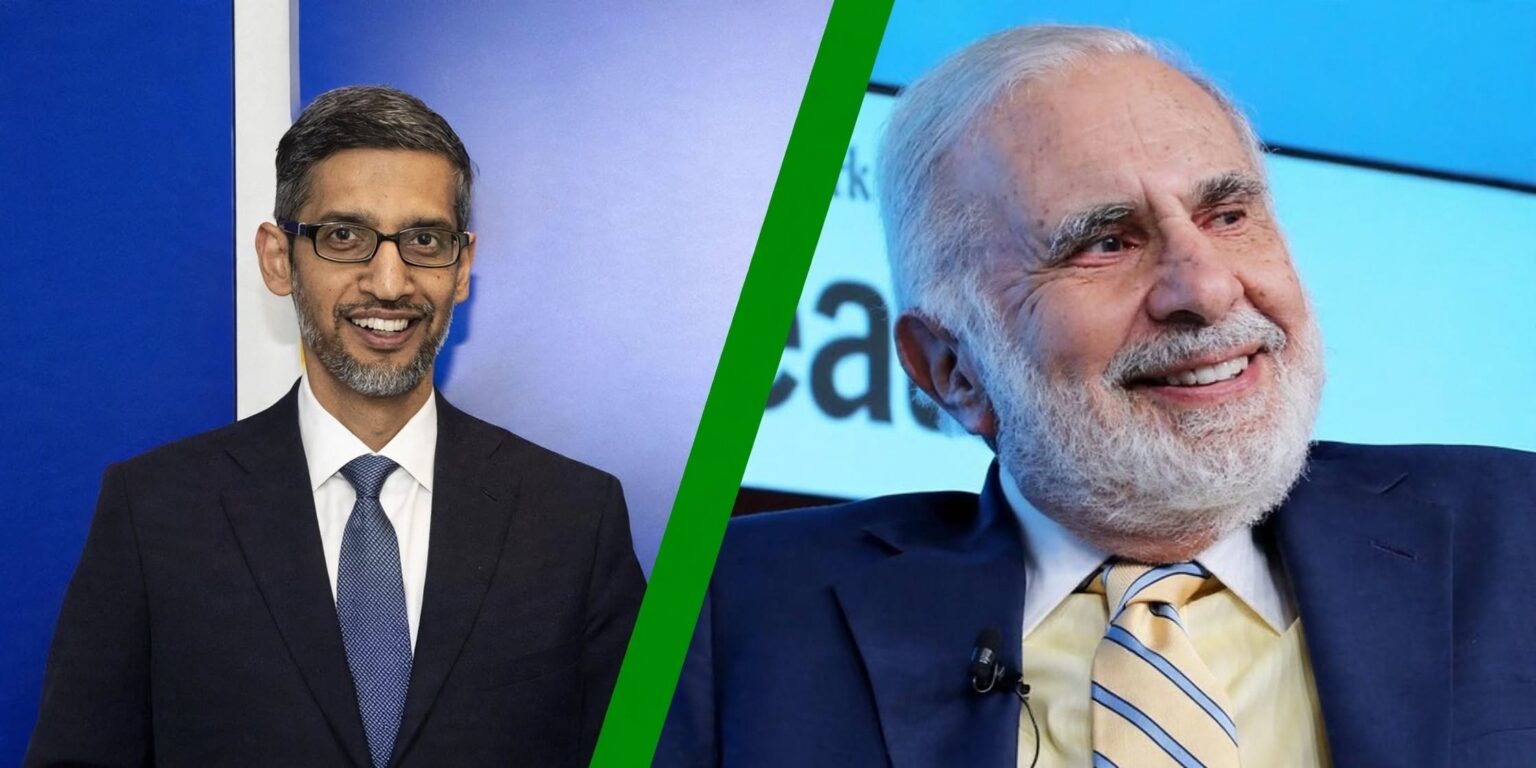

Sundar Pichai and Carl Icahn are two major names in American business, but their careers represent very different kinds of power. Pichai rose through Google’s product organization and now leads both Google and its parent company, Alphabet. Icahn built his reputation as an activist investor who takes stakes in companies and presses management and boards for changes. The public records reviewed for this article do not establish a direct business partnership between Sundar Pichai and Carl Icahn. Their clearest historical overlap is instead connected to Google’s $12.5 billion acquisition of Motorola Mobility in 2011.
| Category | Sundar Pichai | Carl Icahn |
|---|---|---|
| Main field | Technology and corporate leadership | Investing and shareholder activism |
| Best known for | CEO of Google and Alphabet | Activist investing and Icahn Enterprises |
| Current major role | CEO of Alphabet and Google | Chairman of Icahn Enterprises |
| Education | IIT Kharagpur, Stanford, Wharton | Princeton University |
| Joined main organization | Google in 2004 | Built his Wall Street investing career beginning in the 1960s |
| Core approach | Managing products, technology and company strategy | Investing in companies and seeking changes intended to increase shareholder value |
Alphabet’s 2026 proxy states that Pichai joined Google in 2004, became Google CEO in October 2015 and Alphabet CEO in December 2019. Icahn Enterprises identifies Carl Icahn as chairman of its board and says his principal occupation has included managing private investment funds through Icahn Capital.
Are Sundar Pichai and Carl Icahn Business Partners?
There is no documented partnership between the two men in the corporate filings and official records examined for this article. Icahn has not served as a Google or Alphabet executive or director, while Pichai has not held a management position at Icahn Enterprises.
The strongest factual connection between their careers comes from Motorola Mobility, one of the most important technology acquisitions of the early Android era.
At the time, Icahn was a significant Motorola Mobility shareholder. Google was simultaneously considering a transaction that would ultimately bring Motorola’s smartphone business and large patent portfolio under Google’s ownership. Pichai was already working at Google, but he had not yet become the company’s CEO.
The Motorola Mobility Deal Connects Their Business Histories
Carl Icahn owned about 11% of Motorola Mobility
Motorola Mobility’s SEC merger filing provides unusually detailed information about the events preceding Google’s acquisition.
According to the filing, Carl Icahn and his affiliates beneficially owned approximately 11% of Motorola Mobility’s outstanding common stock in July 2011. Icahn and Daniel Ninivaggi, a Motorola director designated by Icahn, contacted Motorola CEO Sanjay Jha and argued that the company should explore alternatives involving its patent portfolio.
Patents had become especially important in the smartphone industry. Technology companies were competing not only through devices and software but also through intellectual-property portfolios that could provide protection in patent disputes.
Google was already talking with Motorola at the time.
Google was negotiating separately with Motorola
Motorola’s merger history states that Google’s discussions involved executives including then-CEO Larry Page, Android chief Andy Rubin, business chief Nikesh Arora and general counsel Kent Walker. Talks progressed from discussions about patents and Motorola’s businesses to the possibility of Google buying the entire company.
Google formally announced the deal on August 15, 2011. It agreed to pay $40 per Motorola Mobility share in cash, valuing the transaction at approximately $12.5 billion. That represented a 63% premium to Motorola Mobility’s closing share price on August 12.
The transaction therefore created an indirect intersection between Icahn’s investing activity and the company where Pichai was building his career.
Was Sundar Pichai Involved in Negotiating the Motorola Acquisition?
The detailed Motorola Mobility SEC filing does not name Sundar Pichai among the Google executives conducting the acquisition negotiations.
That distinction matters. It would be inaccurate to describe the Motorola deal as a transaction personally negotiated between Carl Icahn and Sundar Pichai.
Pichai had joined Google seven years earlier, in 2004, and was already involved in important Google products. His rise to the very top of the company came later. Google announced in 2015 that Pichai would become its CEO as part of the corporate reorganization that created Alphabet. He subsequently became Alphabet CEO in December 2019.
There was interaction between Icahn’s representatives and Google during the Motorola process. A later SEC filing states that Google representatives and Icahn negotiated a possible voting agreement concerning the proposed acquisition. Icahn ultimately would not enter the agreement under the terms available, and Google proceeded with the transaction without such an agreement. The filing does not identify Pichai as a participant in those discussions.
Sundar Pichai’s Career Took a Different Route
Pichai’s influence has come primarily from operating inside one of the world’s largest technology companies.
Alphabet’s 2026 proxy says he has led product and engineering work involving products and platforms including Search, Chrome, Maps, Android, Gmail and Google Workspace. He served as Google’s senior vice president of Android, Chrome and Apps from 2013 to 2014 and senior vice president of Products before becoming Google CEO in 2015.
His role is therefore that of an operator and corporate executive: setting strategy, overseeing major businesses and making long-term decisions about technology development. Alphabet says the company has increasingly centered its strategy on artificial intelligence under his leadership.
Carl Icahn Built His Career From the Investor Side
Icahn’s career followed almost the opposite path.
Rather than spending decades moving upward through the management structure of one corporation, he became famous for acquiring positions in companies and using the influence of ownership to demand changes.
Icahn Enterprises describes him as its chairman and says he has managed private investment funds through Icahn Capital and related entities. Forbes describes Icahn as one of Wall Street’s best-known activist investors and notes that he graduated from Princeton in 1957 before beginning his Wall Street career.
His investing history has included campaigns involving numerous major American corporations. The basic activist model is straightforward: acquire a meaningful ownership position, identify changes an investor believes could improve value, and use shareholder rights to pressure directors or management to consider those changes.
That is essentially what made his Motorola position relevant to Google in 2011.
Sundar Pichai vs. Carl Icahn: Two Forms of Corporate Influence
| Area | Sundar Pichai | Carl Icahn |
|---|---|---|
| Source of influence | Executive authority | Share ownership and investment activity |
| Main perspective | Company operator | Investor and shareholder |
| Primary industry association | Technology | Finance and diversified investments |
| Google connection | CEO of Google and Alphabet | No management role at Google or Alphabet |
| Motorola Mobility connection | Worked at Google during the acquisition period | Approximately 11% Motorola Mobility shareholder in 2011 |
| Role in 2011 merger negotiations | Not named among negotiating executives in Motorola’s SEC history | His representatives discussed patents and a possible voting agreement |
The contrast helps explain why putting the two names together can be useful even without a direct partnership. Pichai represents leadership exercised inside a corporation, while Icahn represents influence exerted through ownership of corporations.
Does Carl Icahn Own Alphabet Stock?
Carl Icahn’s latest publicly filed Form 13F information table for the quarter ended June 30, 2026, filed with the SEC on August 14, 2026, does not list Alphabet among its reported holdings. The filing instead includes positions in companies such as CVR Energy, Caesars Entertainment, JetBlue Airways, EchoStar and International Flavors & Fragrances.
That statement should be interpreted narrowly. A Form 13F shows securities required to be disclosed under that reporting system; the absence of Alphabet means the filing does not show a reportable Alphabet position in the disclosed portfolio for that reporting date. It should not be turned into a broader claim about every possible type of financial exposure.
Frequently Asked Questions
Are Sundar Pichai and Carl Icahn related?
There is no documented family relationship between Sundar Pichai and Carl Icahn. They come from very different professional backgrounds: Pichai is a technology executive, while Icahn built his career in investing.
Have Sundar Pichai and Carl Icahn worked together?
The records examined do not establish a direct professional partnership. Their most significant historical overlap is Google’s 2011 acquisition of Motorola Mobility, in which Icahn was a major Motorola shareholder while Pichai worked at Google.
Did Carl Icahn help Google buy Motorola Mobility?
Icahn did not conduct the acquisition on Google’s behalf. He owned approximately 11% of Motorola Mobility and advocated exploring alternatives involving the company’s patents. Google and Motorola were separately conducting acquisition negotiations that ultimately produced the $12.5 billion deal.
Did Sundar Pichai negotiate with Carl Icahn over Motorola?
Motorola’s detailed SEC account names several Google executives involved in negotiations but does not name Pichai among them. It would therefore be unsupported to claim that Pichai personally negotiated the deal with Icahn.
Is Carl Icahn an Alphabet shareholder?
Icahn’s Form 13F covering June 30, 2026 does not list Alphabet among its reported securities holdings.
What is the main difference between Pichai and Icahn?
Pichai exercises influence by running companies and directing technology strategy. Icahn’s influence has historically come from investing capital, acquiring ownership stakes and pressing companies for financial, strategic or governance changes.
Conclusion
The factual connection between Sundar Pichai and Carl Icahn is much narrower than a partnership or personal business relationship. Their careers crossed indirectly around Google’s 2011 acquisition of Motorola Mobility: Icahn was a major Motorola shareholder, while Pichai was already building his career inside Google. SEC records identify other Google executives—not Pichai—as central participants in the acquisition negotiations.
Their broader comparison is still useful. Pichai represents the power of corporate leadership and technology execution, while Icahn represents the influence that a determined shareholder can exercise from outside management.
Read also: Ray Dalio and Patricia Poppe: Two Paths to Leadership
