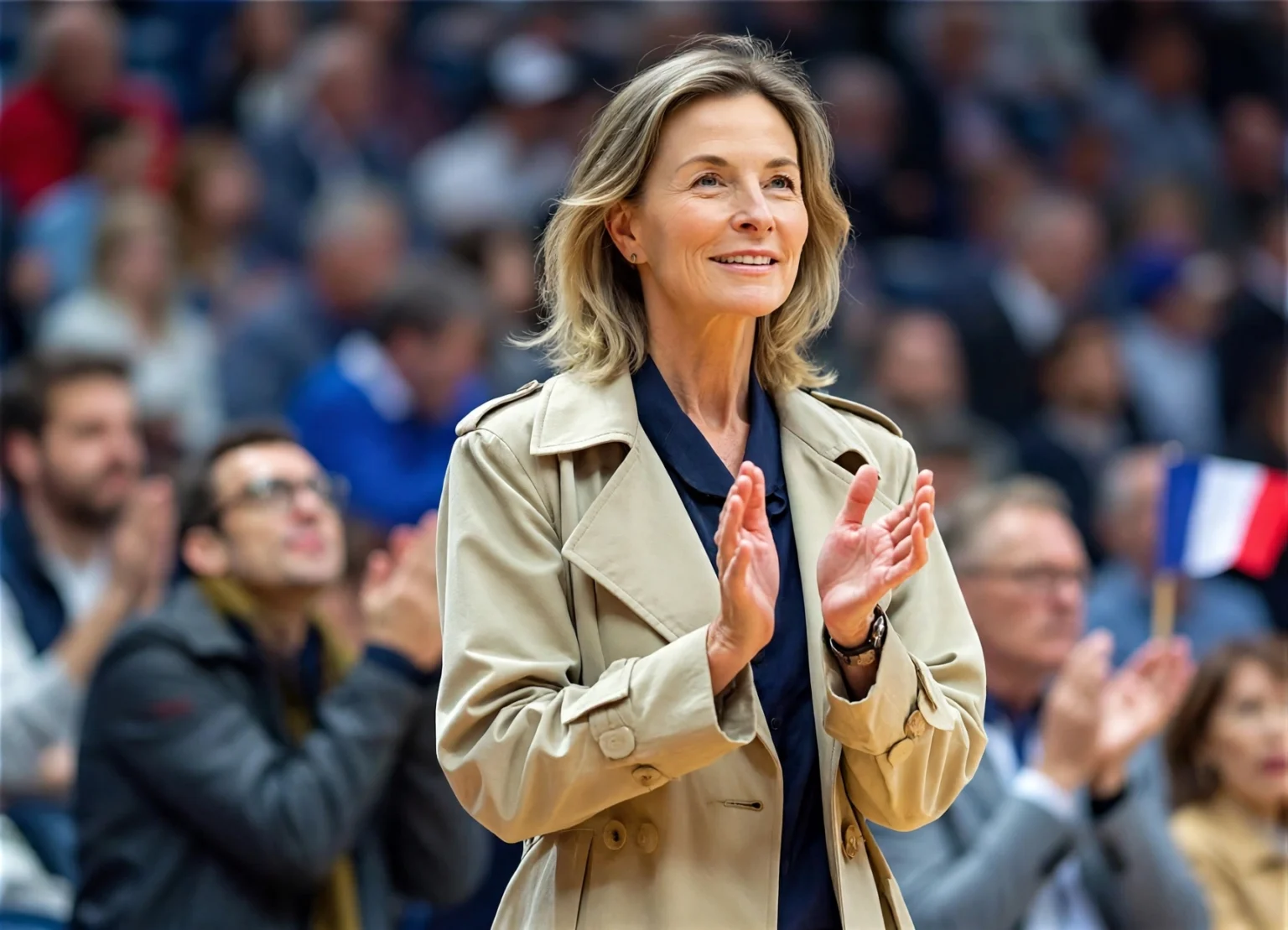

Élodie de Fautereau is a former French basketball player and youth coach best known internationally as the mother of NBA star Victor Wembanyama. Her own sporting record, however, stands on its own: she competed in France’s national leagues, appeared in European club competition with Mosa Jambes, and later taught the game to children at Entente Le Chesnay Versailles 78 Basket. Born on August 12, 1971, de Fautereau comes from a multigenerational basketball family. Her careful balance of expertise and restraint also shaped the sporting environment in which her three children—Ève, Victor and Oscar—grew up.
| Category | Detail |
|---|---|
| Full name | Élodie de Fautereau |
| Date of birth | August 12, 1971 |
| Age | 55 as of September 2026 |
| Nationality | French |
| Height | About 1.91 m (6 ft 3 in) |
| Sport | Basketball |
| Roles | Former high-level player and youth coach |
| Documented teams | Mosa Jambes; Le Chesnay; Le Chesnay-Versailles |
| Family | Félix Wembanyama; children Ève, Victor and Oscar Wembanyama |
FIBA records de Fautereau’s birth date and French nationality, while French newspaper 20 Minutes gives her height as 1.91 metres and traces her playing career through the French national divisions.
From French Youth Basketball to the National Leagues
De Fautereau developed within the strong basketball culture of the Paris region. The Île-de-France Basketball League names her among the players whose development was aided by Jacqueline “Yako” Cator, an influential coach and technical adviser who worked with generations of young female players.
Her senior career included Le Chesnay and Le Chesnay-Versailles. 20 Minutes states that she received French youth-team selections and played as high as Nationale 1. A June 2000 report in Le Parisien offers a useful contemporary snapshot: after Le Chesnay-Versailles dropped to Nationale 2, de Fautereau was one of only two senior players listed as remaining while the club rebuilt its roster.
Archived local match coverage identifies her as an experienced interior player. Those accounts praise her defensive effort, work near the basket and ability to provide points at important moments. They fit the statistical picture preserved in FIBA’s European competition archive.
A Documented European Campaign With Mosa Jambes
FIBA lists de Fautereau as No. 15 for Mosa Jambes in the 1999 Ronchetti Cup, the second tier of European women’s club competition. The database contains six games played between September and November 1998.
| Metric | Total | Per game |
|---|---|---|
| Minutes | 118 | 19.7 |
| Points | 61 | 10.2 |
| Rebounds | 28 | 4.7 |
| Assists | 1 | 0.2 |
| Steals | 7 | 1.2 |
She converted 25 of 49 field-goal attempts, a 51.0 percent rate, and took no three-pointers in those six games. Her best recorded scoring performance was 16 points in 29 minutes, along with eight rebounds. It is a compact statistical record, but it establishes that she was a productive rotation player at European level rather than simply a recreational player later associated with a famous athlete.
Her Work in Mini-Basket Coaching
After her senior playing career, de Fautereau moved into coaching children. The archived Entente Le Chesnay Versailles 78 Basket website names her as the person responsible for its mini-basket school. Mini-basket is the entry point where children learn movement, ball control, passing and the basic rules through age-appropriate sessions.
Victor described his mother’s pupils as roughly four to ten years old. That age range calls for a different kind of coaching from elite development: the aim is to build sound habits and enjoyment before competition becomes more demanding. Her playing background gave her technical knowledge, but the role also required patience and the ability to make the game understandable to beginners.
The local club mattered to the Wembanyama family. An official Versailles Grand Parc account says Victor began basketball at age seven and played for Entente Le Chesnay Versailles from 2011 to 2014 before joining Nanterre 92 at age ten. He therefore started in the same community basketball setting where his mother worked.
How Élodie de Fautereau Influenced Victor Wembanyama
De Fautereau introduced Victor to a basketball environment, but she did not try to control his advanced training. In a EuroLeague interview quoted by People, Victor explained that he never trained with his mother “for performance.” He said she understood when a parent should step back rather than become too involved in a child’s sporting path.
That boundary is central to her influence. Victor had easy access to gyms, coaches and basketball knowledge, yet the decision to pursue the sport remained his. His parents also encouraged schoolwork and resisted preferential treatment as his talent became apparent. Such choices separate exposure from pressure: de Fautereau gave her son a foundation without presenting herself as the architect of his professional career.
Her influence also extended beyond technique. A coach of beginners teaches attention, coordination, teamwork and respect for practice. Victor later moved through Nanterre, ASVEL and Metropolitans 92 before becoming the first pick in the 2023 NBA Draft, but his earliest organized experience began in the local structure his mother helped run.
Basketball Across the De Fautereau-Wembanyama Family
The family’s connection to basketball predates Élodie’s own career. Her father, Michel de Fautereau, played center for Paris University Club in the French first division during the 1960s. Her mother, Marie-Christine, also played basketball. Élodie therefore grew up with the sport before passing it to another generation.
Félix Wembanyama came from track and field, competing in jumping events. Their three children all entered competitive basketball. Ève has represented France in youth and 3×3 competition; Victor became an NBA player and French international; Oscar developed within the French club system. This combination of basketball experience and track-and-field knowledge created a broad athletic household rather than a single-sport training project.
The family appeared together at the 2023 NBA Draft when San Antonio selected Victor first overall. The moment brought worldwide attention to Élodie, but it did not begin her basketball story. By then, she had already been a player in France’s national leagues, a European club competitor and a teacher of young children.
Frequently Asked Questions
Who is Élodie de Fautereau?
She is a French former basketball player and youth coach. She is also the mother of basketball players Ève, Victor and Oscar Wembanyama.
How old is Élodie de Fautereau?
She was born on August 12, 1971. She turned 55 in August 2026.
How tall is Élodie de Fautereau?
20 Minutes lists her at 1.91 metres, or approximately 6 feet 3 inches. FIBA’s player profile does not supply a height.
Did Élodie de Fautereau play professional basketball?
She played at high national level in France and appeared in FIBA European club competition for Mosa Jambes. FIBA recorded averages of 10.2 points and 4.7 rebounds across six Ronchetti Cup games.
Did Élodie de Fautereau play for France?
20 Minutes identifies her as a former French youth selection. Some English-language biographies describe senior national-team service, but FIBA’s accessible player page does not list senior appearances; the most precise description supported by the French record is former youth international.
Was Élodie de Fautereau Victor Wembanyama’s coach?
She coached young children and helped introduce Victor to basketball, but he has said she did not train him for elite performance. His organized club development continued at Le Chesnay-Versailles and then Nanterre.
Conclusion
Élodie de Fautereau’s biography is more than a footnote to Victor Wembanyama’s success. The record shows a high-level French player who reached European competition, an experienced interior for Le Chesnay-Versailles and a coach trusted with the youngest age groups. Her most distinctive contribution may be the boundary she maintained: basketball was always available, but her children retained ownership of their paths. That blend of expertise, access and restraint defines her place in one of modern basketball’s best-known families.
Read also: Jeannine Belleguic: Biography, Life, Family Name and Key Facts
