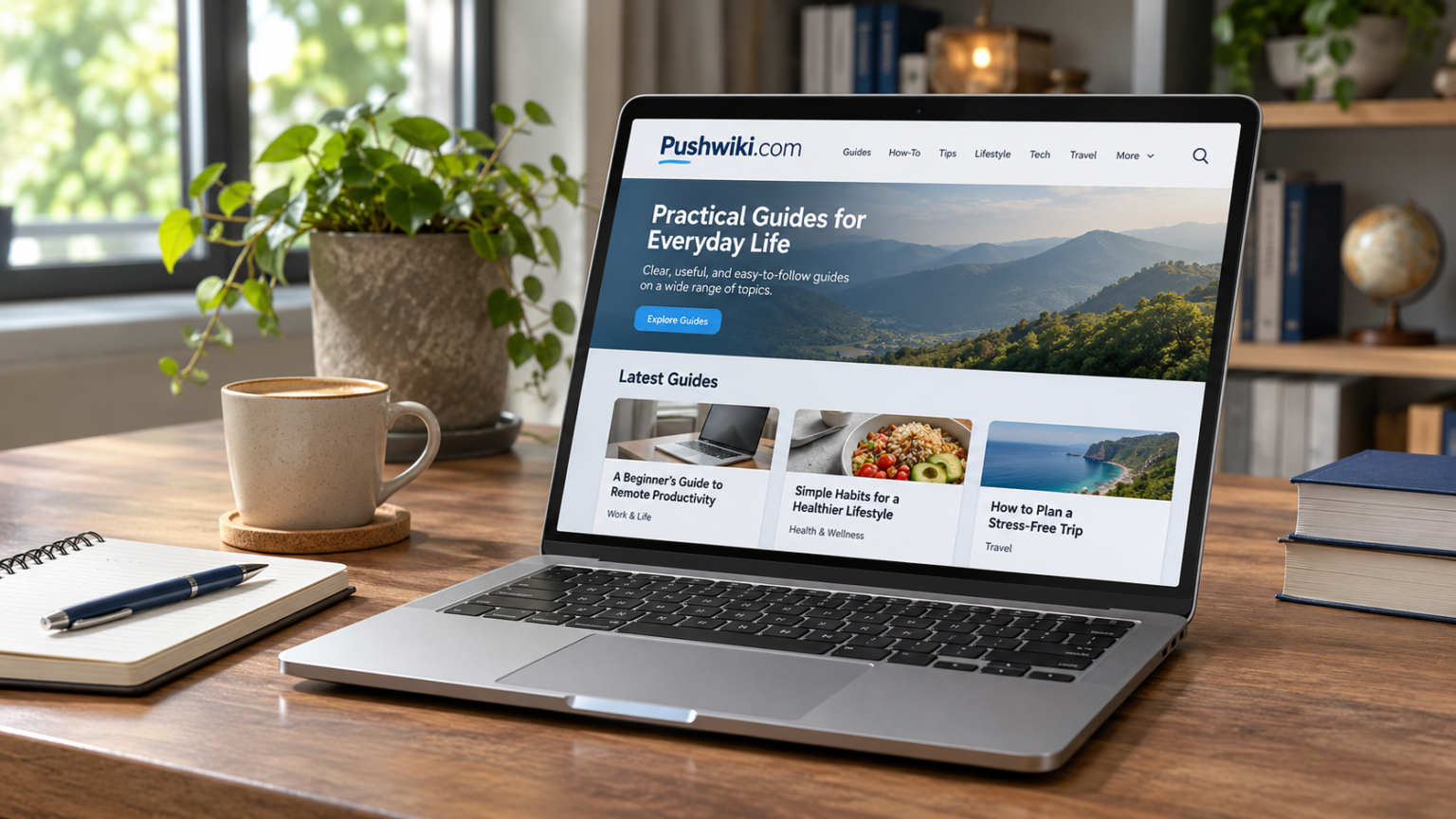

Pushwiki.com is a free, English-language information website covering business, technology, finance, health, education, law, travel, and lifestyle. It publishes guides and articles and lists several basic online tools; its visible format is an online publication rather than a publicly editable encyclopedia. Its homepage provides topic categories, article search, featured stories, and links to recently updated content.
The exact address matters. Pushwiki.com and push-wiki.com are different domains with different published descriptions. If you searched for “pushwiki com,” checking that spelling is the first step toward finding the website you intended.
What can you find on Pushwiki.com?
Pushwiki’s coverage spans everyday questions and specialist subjects. Alongside its main categories, the homepage includes digital marketing and lifestyle sections. Articles linked there cover subjects such as road-trip fuel budgeting, AI chatbots, smartphone features, and online services.
Readers can browse by topic, use the search box, or follow the featured and recently updated article lists. That makes the site straightforward to approach as a collection of introductory reading rather than a single-purpose service.
Its Free Tools page lists three utilities:
- Word and Character Counter for text counts and related writing statistics.
- Citation Generator for references in APA, MLA, and Chicago styles.
- Date Difference Calculator for intervals between dates and related calculations.
Pushwiki says these tools require no sign-up and run in the browser. It also says advertising and affiliate links support the site. These are the publisher’s descriptions, rather than an independent assessment of the tools’ performance or privacy protections.
Why the hyphen changes which website you visit
The About Us page at push-wiki.com describes a technology-focused publication covering tech news, AI tools, product reviews, and how-to guides. It identifies someone named Martin as its founder and lead editor. Those statements concern the hyphenated domain.
By contrast, the unhyphenated Pushwiki.com describes a broader publication covering subjects from business to travel. Information about the founder, editorial team, or services of one address should not automatically be attributed to the other. Their similar branding does not establish common ownership.
For readers, the practical distinction is simple: use pushwiki.com when you mean the general-interest website discussed here.
Can readers edit it like a wiki?
The pages reviewed present an article-publishing model, with no visible invitation to edit published entries directly.
Instead, Pushwiki’s Write for Us page invites contributors to pitch original, researched articles through its contact page. It asks writers to provide useful material with linked sources. That is a submission process, not evidence of open community editing. The word “wiki” in the name should therefore not be taken as a description of how readers can contribute.
How transparent is Pushwiki about its editorial standards?
The most concrete concern is unfinished information on its own policy pages.
When checked on November 10, 2026, the About Us page still used placeholder wording where the operator’s name and experience should appear. It stated that the site checks facts against original sources, but did not provide a completed introduction to the person responsible for running it.
The Editorial Policy also contained a placeholder in its research section instead of a finished explanation of research and testing methods. Elsewhere, it said advertisers do not approve stories before publication, significant corrections are noted, and sponsored posts are labeled. These are stated policies; their presence alone does not demonstrate consistent compliance.
These gaps limit readers’ ability to assess accountability and expertise. They do not, by themselves, establish fraud. Equally, a functioning homepage and published policies are insufficient grounds for declaring a website comprehensively safe or its articles consistently accurate. This review establishes what the public pages display, not a technical security certification.
How to judge an article before relying on it
Assess the specific page you plan to use, especially when it makes claims that could affect a purchase, health decision, or understanding of legal rights.
Look for a named author, a relevant publication or update date, and links that support the central claim. Follow those links: a reference to a manufacturer’s specification, original study, or government notice is more useful than another general article repeating the same statement.
For time-sensitive information, check whether the underlying source remains current. For legal or financial rules, confirm which country or jurisdiction the article concerns. A broad English-language website may cover subjects that do not apply where you live.
Pushwiki.com can provide topics and explanations to investigate further. Whether an individual article deserves your trust depends on its evidence, sourcing, and relevance to your question.
Sources
- Pushwiki — Homepage. https://pushwiki.com/
- Pushwiki — Free Tools. https://pushwiki.com/tools/
- Pushwiki — About Us. https://pushwiki.com/about-us/
- Pushwiki — Editorial Policy. https://pushwiki.com/editorial-policy/
- Pushwiki — Write for Us. https://pushwiki.com/write-for-us/
- Pushwiki com, hyphenated domain — About Us. https://push-wiki.com/about-us/
