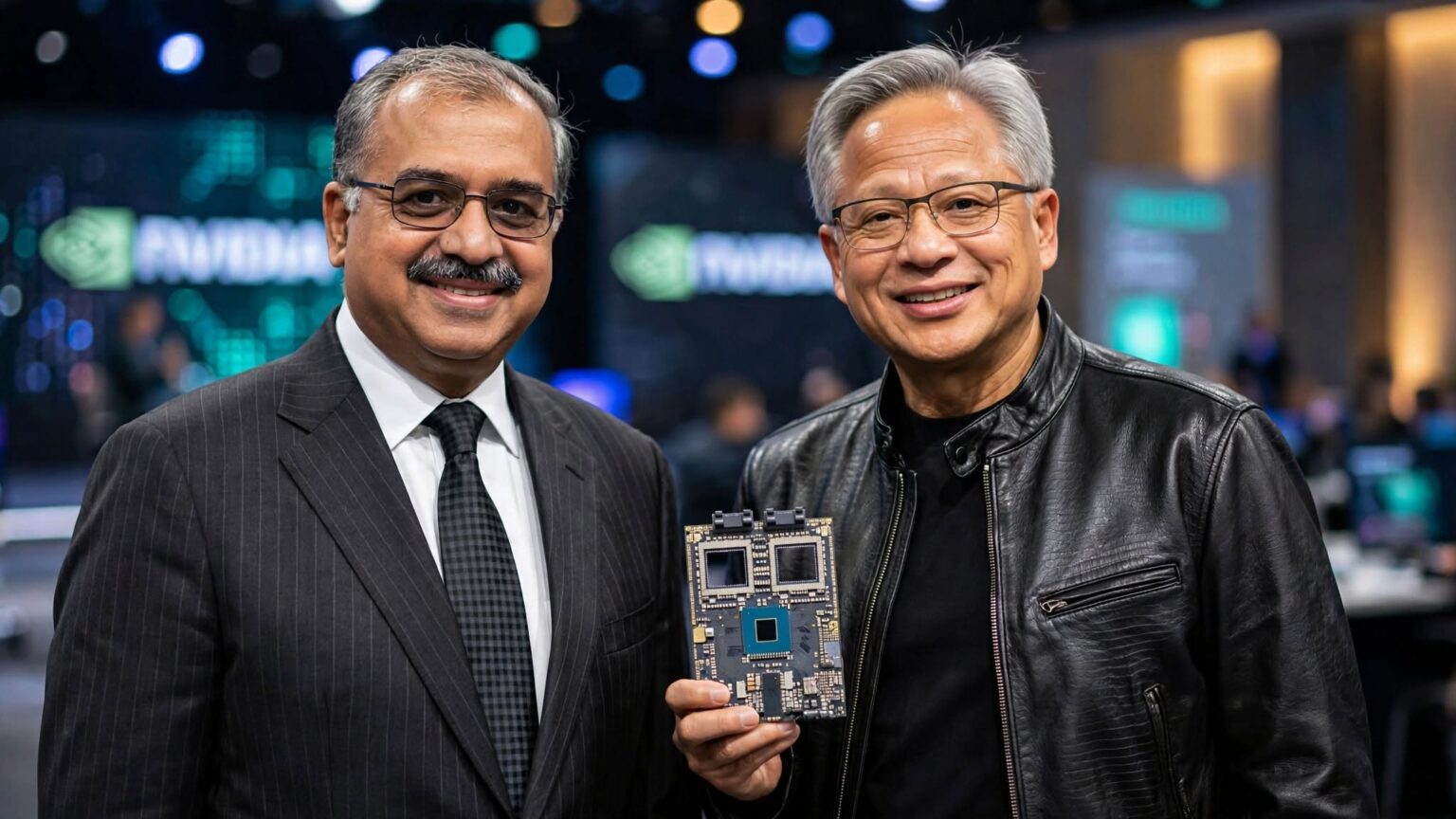

Dilip Shanghvi and Jensen Huang built their fortunes in industries that could hardly look more different. Shanghvi turned a small Indian pharmaceutical venture into Sun Pharmaceutical Industries, a global drugmaker, while Huang co-founded NVIDIA and helped transform it from a graphics-chip company into a central player in accelerated computing and artificial intelligence. Both are self-made billionaires who remained closely associated with the companies they helped create, but their business models, career paths, and sources of wealth differ substantially. There is no established business partnership between the two; the useful comparison is how each founder built and retained influence over a major global company.
| Detail | Dilip Shanghvi | Jensen Huang |
|---|---|---|
| Primary industry | Pharmaceuticals | Semiconductors, AI and accelerated computing |
| Best known for | Founder of Sun Pharmaceutical Industries | Co-founder and CEO of NVIDIA |
| Company founded | Sun Pharma, 1983 | NVIDIA, 1993 |
| Current leadership role | Executive Chairman, Sun Pharma | Founder, President and CEO, NVIDIA |
| Education | Commerce graduate, University of Calcutta | BSEE, Oregon State University; MSEE, Stanford University |
| Forbes net worth estimate | $26.4 billion as of Sept. 10, 2026 | $187.4 billion as of Sept. 16, 2026 |
| Primary source of wealth | Pharmaceuticals | NVIDIA equity / semiconductors |
Sun Pharma identifies Shanghvi as its founder and executive chairman, while NVIDIA says Huang has served as president and CEO since the company was established in 1993. Education details come from the companies’ own corporate records. Net-worth figures are estimates and can change with asset and share prices.
Who Is Dilip Shanghvi?
Dilip Shanghvi is an Indian entrepreneur best known for founding Sun Pharmaceutical Industries in 1983. His background gave him early exposure to the medicine business: Forbes describes him as the son of a pharmaceutical distributor. He started Sun Pharma with money borrowed from his father and initially concentrated on psychiatric medicines. Sun Pharma’s own corporate history says the business began with five psychiatry products and a two-person marketing team.
That modest operation eventually developed into India’s largest pharmaceutical company by domestic market position. Sun Pharma says it now generates about $6.2 billion in global revenue, operates 41 manufacturing facilities and supplies medicines to more than 100 countries. The company has expanded well beyond traditional generic drugs into specialty pharmaceuticals and differentiated products.
The acquisition strategy behind Sun Pharma’s growth
Acquisitions became an important part of Shanghvi’s expansion strategy. The most prominent was the agreement to acquire Ranbaxy Laboratories in a transaction valued at approximately $4 billion. Announced in April 2014, the combination was completed in March 2015. Sun Pharma said at the time that the transaction would create the world’s fifth-largest specialty generic pharmaceutical company.
Sun has continued making acquisitions. Its corporate milestones include the 2023 purchase of Concert Pharmaceuticals and the 2025 acquisition of Checkpoint Therapeutics in the United States.
Shanghvi remains executive chairman of Sun Pharma and also chairs Sun Pharma Advanced Research Company. He received India’s Padma Shri in 2016 for his contribution to trade and industry.
Who Is Jensen Huang?
Jensen Huang is the co-founder, president and CEO of NVIDIA, the semiconductor and computing company he established in 1993 with Chris Malachowsky and Curtis Priem. Before NVIDIA, Huang worked at AMD and LSI Logic. He earned an electrical engineering bachelor’s degree from Oregon State University and a master’s degree from Stanford University.
NVIDIA began with a focus on 3D graphics for gaming and multimedia. The company’s history marks 1999 as a pivotal year, when NVIDIA introduced what it called the GPU, or graphics processing unit. Another major turning point arrived in 2006 with CUDA, which opened NVIDIA GPUs to broader parallel-computing workloads.
Those technologies eventually became highly important to machine learning and AI. NVIDIA hardware powered the breakthrough AlexNet neural network in 2012, and the company has since expanded into AI infrastructure, data centers, robotics, automotive computing and other areas. NVIDIA reported record full-year revenue of $215.9 billion for fiscal 2026.
Huang has remained CEO throughout NVIDIA’s history, an unusually long tenure for the founder of a large publicly traded technology company.
Dilip Shanghvi vs Jensen Huang: How Their Careers Compare
The most important similarity between Dilip Shanghvi and Jensen Huang is that both built businesses around specialized markets before expanding far beyond their initial niches.
Shanghvi started with psychiatric medicines before Sun Pharma broadened into cardiology, generics, specialty medicines and international pharmaceutical markets. Huang began with computer graphics before NVIDIA’s GPU technology found applications in scientific computing, data centers and artificial intelligence.
Their routes to expansion were different, however. Sun Pharma used both organic growth and major acquisitions, including Ranbaxy. NVIDIA’s transformation was driven heavily by computing architecture, software ecosystems such as CUDA and increasing demand for GPU-based accelerated computing.
Key milestones
| Year | Dilip Shanghvi / Sun Pharma | Jensen Huang / NVIDIA |
|---|---|---|
| 1983 | Sun Pharma established with five psychiatry products | — |
| 1993 | Sun Pharma was already expanding its pharmaceutical business | NVIDIA founded |
| 1999 | — | NVIDIA introduces the GPU |
| 2006 | — | CUDA architecture unveiled |
| 2014–15 | Ranbaxy acquisition announced and completed | NVIDIA continues expansion in accelerated computing |
| 2023 | Sun Pharma acquires Concert Pharmaceuticals | AI-driven demand becomes increasingly central to NVIDIA’s business |
| 2025 | Sun Pharma acquires Checkpoint Therapeutics | NVIDIA continues expanding AI infrastructure |
| 2026 | Shanghvi serves as Sun Pharma executive chairman | Huang remains NVIDIA president and CEO |
The Sun Pharma milestones come from the company’s corporate history and transaction records; NVIDIA’s technology milestones are documented in its official company timeline.
Dilip Shanghvi and Jensen Huang Net Worth
The wealth gap between the two founders is substantial, largely because Huang’s fortune is tied to NVIDIA’s enormous stock-market valuation.
Forbes estimated Jensen Huang’s net worth at $187.4 billion on September 16, 2026, placing him among the world’s wealthiest individuals at that time. Forbes attributes most of his fortune to his ownership interest in NVIDIA.
Forbes estimated Dilip Shanghvi’s net worth at $26.4 billion on September 10, 2026. His wealth is primarily associated with pharmaceuticals and his interest in Sun Pharma.
These figures should not be treated as fixed salaries or cash holdings. Billionaire net-worth estimates can rise or fall rapidly as public-company share prices and other asset valuations change.
What Makes Their Business Stories Different?
Shanghvi’s career is closely connected with the globalization of an Indian pharmaceutical manufacturer. Sun Pharma grew from a tiny domestic operation into a company selling medicines across more than 100 countries. Its expansion combined pharmaceutical development with manufacturing scale and acquisitions.
Huang’s story centers on a technological platform. NVIDIA began by addressing computer graphics but developed GPU computing into an architecture used across gaming, scientific research, AI, robotics and data-center infrastructure. Its evolution illustrates how a technology originally designed for one computing problem can become valuable in entirely different markets.
Their stories therefore offer two distinct examples of founder-led corporate growth: Shanghvi through pharmaceuticals, international expansion and dealmaking; Huang through computing architecture, software and repeated technological shifts.
FAQs About Dilip Shanghvi and Jensen Huang
Are Dilip Shanghvi and Jensen Huang business partners?
No established partnership between them appears in the corporate histories of Sun Pharma or NVIDIA. Shanghvi is associated primarily with pharmaceuticals through Sun Pharma, while Huang’s career is centered on NVIDIA and computing.
Who is richer, Dilip Shanghvi or Jensen Huang?
Forbes estimated Jensen Huang at $187.4 billion on September 16, 2026, compared with $26.4 billion for Dilip Shanghvi on September 10, 2026. Because both fortunes depend partly on market valuations, the figures change over time.
What company did Dilip Shanghvi found?
Shanghvi founded Sun Pharmaceutical Industries in 1983. It began with five psychiatry products and later developed into India’s largest pharmaceutical company by domestic market position.
What company did Jensen Huang found?
Huang co-founded NVIDIA in 1993 with Chris Malachowsky and Curtis Priem. He has served as its president and CEO since its founding.
What is Jensen Huang best known for?
Huang is best known for leading NVIDIA and its expansion from PC graphics into GPU-accelerated computing and AI infrastructure. NVIDIA introduced the GPU in 1999 and CUDA in 2006, two important milestones in that development.
What is Dilip Shanghvi best known for?
Shanghvi is best known for building Sun Pharma from a small pharmaceutical operation into a global specialty and generic drug company and for overseeing major expansion moves such as the Ranbaxy acquisition.
Conclusion
Dilip Shanghvi and Jensen Huang belong to different industries, countries and business traditions, yet their careers share a clear foundation: both stayed closely involved with companies they helped build from relatively modest beginnings into global enterprises. Shanghvi’s Sun Pharma story is rooted in pharmaceuticals, acquisitions and international expansion. Huang’s NVIDIA story developed through GPUs, accelerated computing and AI. Comparing them is therefore less about a direct relationship and more about two very different routes to creating enduring founder-led businesses.
Read also Miguel Patricio and Albert Bourla: Two Global Executives With Very Different Career Paths
