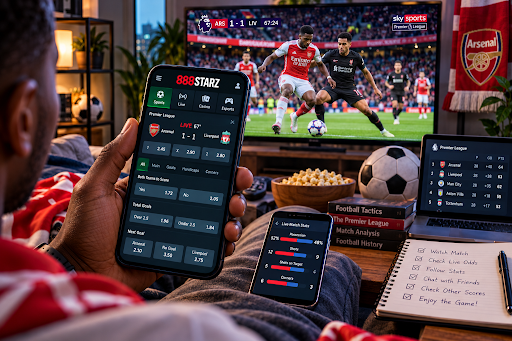

Watching football used to mean paying attention to one screen. The television showed the match, the commentator supplied the context and supporters argued about what they had just seen.
That experience now looks very different. A phone is rarely far away. Supporters check line-ups before kick-off, follow live statistics, message friends, watch clips from other matches and monitor changing information while the game is still being played. In mobile-first markets, platforms such as 888starz kenya also place live sports markets inside that same second-screen environment, alongside scores, match data and other digital football content.
The result is not simply that football has become more digital. The match itself is increasingly experienced through two parallel feeds: what is happening on the pitch and what is happening on the phone.
The Second Screen Is No Longer a Distraction From the Match
The phrase “second screen” once sounded like something competing with television.
That is no longer the best way to think about it.
For many supporters, the smartphone is now part of watching the match.
A fan may be following Arsenal against Liverpool on television while simultaneously checking:
– expected line-ups;
– live possession statistics;
– shots and expected goals;
– other Premier League scores;
– fantasy football points;
– group chats;
– social media reactions;
– live odds;
– injury updates.
The phone does not necessarily pull the viewer away from football.
In many cases, it adds another layer to the same event.
This fits a much wider change in online behaviour. Ofcom reported in its 2025 Online Nation research that UK adults were spending an average of around four and a half hours online per day, with most online time occurring on smartphones. The average adult used around 41 apps per month.
A football match is therefore entering an environment where constant mobile interaction is already normal.
Football Has Become a Live Data Product
The modern football viewer has access to information that once belonged largely to professional analysts.
A supporter can now see possession, shots, passes, player positions and other statistics within seconds.
The television commentator may say that one team is dominating.
The viewer can immediately check whether the numbers support that impression.
That changes how people talk about the match.
A team can be losing 1-0 but still have more possession, more shots and better attacking statistics. Twenty years ago, many viewers would have relied almost entirely on what they saw and what the commentator told them.
Today, the phone provides another interpretation.
Information Arrives Before the Broadcast Can Explain It
Television remains excellent at showing the match.
It is less efficient at answering every question a viewer might have.
Who has been booked?
How many corners has each team had?
What are the results in the other matches?
Has a player been substituted because of an injury?
What does the league table look like if the current score remains unchanged?
Those are second-screen questions.
A supporter can answer them without waiting for the broadcast graphics.
What Fans Actually Use the Second Screen For
The modern football phone is doing several different jobs at once.
Second-screen activity | What it adds to the match
Live scores | Updates from other fixtures
Match statistics | Context behind the scoreline
Messaging | Conversation with friends during the game
Social media | Immediate fan and media reaction
Fantasy football | Real-time points and player performance
Video clips | Replays and moments from other matches
Live betting | Markets that react to events during the game
News alerts | Injuries, transfers and breaking developments
The interesting point is that these activities are beginning to overlap.
A supporter may receive news about an injury, check the player’s statistics, discuss it in a WhatsApp group and then look at how the match market has changed — all within a minute.
Digital football no longer has clear boundaries between watching, analysing and reacting.
Live Betting Is Built for the Second-Screen Era
Live betting is one of the clearest examples of how football’s digital environment has changed.
Traditional sports betting happened largely before the event.
A supporter selected the result, the match started and the bet was effectively finished until the final whistle.
In-play betting works differently.
The market continues to move as the match develops.
A goal changes the price.
A red card changes the price.
Time running out changes the price.
An injury to an important player may change expectations even before the score changes.
The UK Gambling Commission’s 2025–26 industry statistics illustrate the scale of online sports betting. Remote betting generated about £2.4 billion in Gross Gambling Yield during the financial year, with football contributing roughly £1.2 billion.
Data from the Commission’s largest online operators also recorded more than six million active real-event betting accounts in March 2026 alone, although one person can of course hold more than one account.
This does not mean every football viewer is betting.
It shows that live sport and online wagering now exist within the same large digital ecosystem.
Kenya Shows How Far Mobile-First Football Can Go
The second-screen trend is particularly visible in countries where mobile services are already deeply integrated into everyday life.
Kenya is a useful example.
Safaricom reported 35.82 million one-month active M-Pesa users in FY2025, with KSh38.29 trillion in transaction value passing through the service over the year.
That matters because a smartphone in such a market is not simply a communications device.
It can be a television companion, payment tool, news terminal, sports-data service and entertainment platform at the same time.
Football products designed for Kenyan users therefore have good reason to prioritise mobile access.
The same principle applies elsewhere, but the Kenyan market makes the relationship particularly obvious: football consumption develops on top of infrastructure people already use every day.
Why Live Statistics Can Be More Useful Than Commentary
Commentary is interpretation.
Statistics are another form of interpretation.
Neither gives a complete picture by itself.
A team having 70 percent possession does not necessarily mean it is playing well. Most of that possession may be harmless passes between defenders.
Similarly, a team with only three shots may still have created the three best chances of the game.
Second-screen data is therefore most useful when it supplements what the viewer sees rather than replacing it.
Useful numbers during a football match can include:
Shots on Target
A team taking ten shots but putting only one on target may be less threatening than the total suggests.
Expected Goals
Expected-goals models attempt to measure the quality of scoring chances.
Different providers calculate xG slightly differently, so it should not be treated as an absolute truth.
Possession
Possession can reveal which side controls the ball, but not necessarily which side controls the danger.
Corners and Set Pieces
These can provide clues about territorial pressure.
Again, the context matters.
A team may win several corners without creating a serious scoring opportunity.
The second screen provides data.
The viewer still has to interpret it.
Social Media Has Created a Parallel Stadium
Football has always been social.
Fans talked in pubs, living rooms and stadium stands.
Phones have simply expanded the size of the conversation.
During a major Champions League or Premier League match, thousands of reactions appear within seconds of an important incident.
A controversial penalty can produce:
– replay clips;
– screenshots;
– referee analysis;
– memes;
– fan arguments;
– journalists’ opinions;
– former players’ reactions.
Before the match has even restarted, a parallel debate may already be taking place online.
This can make football more communal, particularly for fans watching alone.
But it can also create a strange effect.
The viewer may spend more time reading what everyone else thinks happened than forming an opinion from the match itself.
Notifications Have Changed the Rhythm of Watching Football
The traditional football broadcast controls the pace.
Kick-off.
Half-time.
Full-time.
The smartphone follows a different rhythm.
Notifications arrive whenever something happens.
A goal in another game.
A fantasy football update.
A red card.
A transfer story.
A message from a friend.
An updated score.
That means one match can compete with several other football stories at the same time.
For broadcasters, clubs and digital platforms, attention has become a scarce resource.
It is no longer enough to simply show the game.
The entire digital ecosystem is competing to become the viewer’s second destination.
The Risk of Turning Every Moment Into a Decision
There is also a downside to the second-screen model.
Information encourages interaction.
Interaction can encourage another decision.
This is particularly relevant to live betting.
A pre-match bet provides a natural pause. Once the match begins, the decision has already been made.
Live markets remove that pause.
A player can react continuously to changing prices.
That creates opportunities, but it can also encourage impulsive decisions after goals, missed chances or previous losses.
The Gambling Commission has previously found strong use of mobile devices among people participating in in-play betting, highlighting how closely the product is tied to smartphones.
The useful principle is straightforward:
more information does not remove uncertainty from sport.
A team can dominate the statistics and still concede from one counterattack.
A highly rated favourite can lose.
A red card can transform a match.
Digital tools can improve information.
They cannot guarantee the outcome.
How to Use a Second Screen Without Letting It Take Over
Fans do not need to put their phones away completely.
The better approach is to decide what the second screen is for.
For example:
1. Check team news before kick-off.
2. Follow a limited number of useful live statistics.
3. Keep notifications from unrelated apps muted.
4. Avoid reacting to every short-term change in the match.
5. Treat live odds as probabilities, not predictions.
6. Set financial limits before using any betting service.
7. Give the actual match more attention than the commentary around it.
The purpose of the second screen should be to add context.
If it becomes the main screen, the experience changes completely.
Are Football Fans Becoming More Analytical?
In one sense, yes.
Supporters have access to more information than ever before.
Terms such as xG, progressive passes, pressing and shot quality are now part of ordinary football conversations.
Fantasy football has also encouraged millions of fans to pay attention to statistics for individual players.
Betting markets add another layer because odds translate expectations into numbers.
But access to data does not automatically create better analysis.
The danger is confusing quantity with understanding.
A supporter who checks ten statistics without context may know less than someone who watches the shape of the match carefully.
The strongest analysis combines both.
Watch the game.
Then use the data to test what you think you are seeing.
The Television Is Still the Main Event
Despite all the technology surrounding football, something important has not changed.
People still care about the match.
The goal remains the moment that matters.
The crowd reaction still matters.
The final whistle still matters.
Phones can explain, amplify and extend those moments.
They cannot fully reproduce them.
That may be why the second-screen model has succeeded.
It does not try to replace football.
It attaches itself to the parts of football the broadcast cannot provide fast enough.
Frequently Asked Questions
What is second-screen viewing?
Second-screen viewing means using another device, usually a smartphone or tablet, while watching content on a television or primary display.
Why do football fans use phones during matches?
Common reasons include checking statistics, following other scores, messaging friends, viewing social-media reactions, managing fantasy teams and following live markets.
Is live betting different from pre-match betting?
Yes. Pre-match betting takes place before an event starts. Live or in-play betting allows markets to continue changing while the sporting event is happening.
Can live statistics predict the result of a football match?
No. Statistics can provide useful information about how a match is developing, but football remains unpredictable and individual events can change the outcome.
Why is mobile betting significant in Kenya?
Kenya has a mature mobile-first digital economy, including widespread use of mobile money. That infrastructure makes smartphones particularly important for many forms of online entertainment and financial activity.
Is more football data always better?
Not necessarily. Data is useful when it answers a specific question. Too many statistics can create noise rather than insight.
The Match Has Not Changed — The Way We Watch It Has
Football still lasts roughly 90 minutes.
There are still two teams, one ball and one final score.
What has changed is everything surrounding those 90 minutes.
The modern viewer can watch the match while following statistics, discussing decisions with hundreds of other supporters, checking other scores and interacting with digital services in real time.
The smartphone has become football’s permanent companion.
The most interesting question is no longer whether fans will use a second screen.
They already do.
The question is how much of the match they want that second screen to control.
Sources & Evidence
Ofcom — From apps to AI search: how the UK goes online in 2025
UK Gambling Commission — Industry statistics annual report, April 2025 to March 2026
UK Gambling Commission — Gambling business data to March 2026
Safaricom — FY2025 Earnings Booklet
https://www.safaricom.co.ke/images/Downloads/FY25-Earnings-Booklet_May-9-2025.pdf
UK Gambling Commission — Taking a more in-depth look at online gambling
