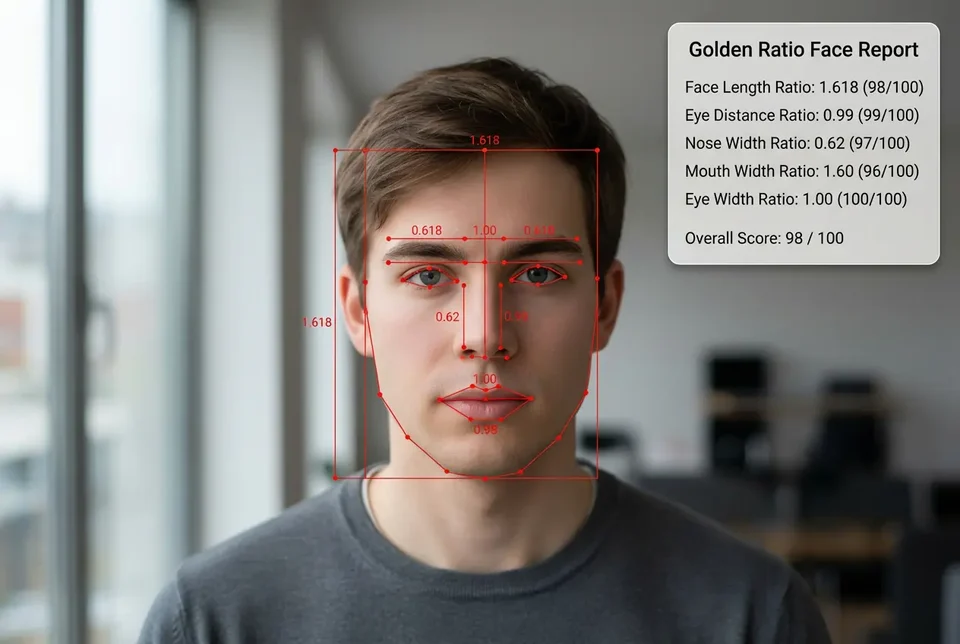

The golden ratio is a mathematical proportion of approximately 1.618 that, in facial analysis, is used to compare measurements such as facial length, width, eye spacing, and nose placement to assess balance and visual harmony. For anyone curious about facial proportions, exploring AI face analysis tools like Facefy, or using facial geometry to guide personal styling or makeup decisions, it offers a structured way to look at how features relate to one another.
AI face analysis tools make these comparisons more accessible by examining facial landmarks in photographs. This guide explains how golden ratio analysis works, how to interpret AI-generated results, how it differs from facial symmetry, which common myths to ignore, and how facial proportions can inform practical choices in hairstyling, makeup placement, and photography composition. A golden ratio score is not a scientifically established measure of attractiveness, but it can still be a useful reference for understanding facial balance while recognizing that beauty is diverse and not defined by a single number.
What Is the Golden Ratio (Divine Proportion) in Facial Analysis?
The golden ratio, also known as the golden section, golden number, and golden proportion, is a mathematical concept and ratio describing a relationship between two numbers.
Its approximate value is 1.618, with the golden ratio φ named by the Greek letter phi as a special number approximately equal to that value.
In a line example, a line segment is divided so the whole length divided by the longer part equals the longer part divided by the smaller part.
In facial analysis, this proportion is sometimes applied to distances between facial landmarks, including the hairline, chin, cheekbones, eyes, and mouth.
The concept has a long history in mathematics, art, architecture, and the use of the golden ratio in visual composition. Luca Pacioli explored divine proportion during the Renaissance in a work illustrated by Leonardo da Vinci.
Art historians also discuss claimed examples such as the Parthenon in Athens, though some of those claims are disputed.
However, mathematical harmony does not establish a universal standard of facial beauty.
How AI Face Analysis Tools Use the Golden Ratio
AI face analysis typically identifies facial landmarks and compares selected measurements.
These tools compare selected distances and angles, but the same ratio in a face does not by itself prove beauty or harmony.
These calculations describe geometric relationships rather than determining whether someone is attractive.
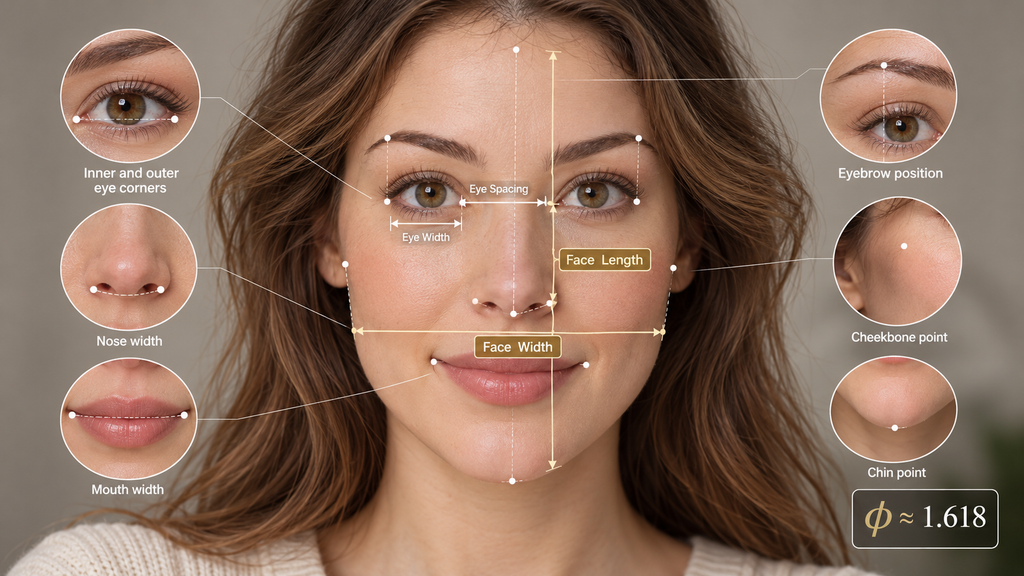
1. Facial Length-to-Width Ratio
A common measurement divides facial height by facial width.
For example, a face measuring 18 centimeters in height and 12 centimeters in width has a ratio of 1.5.
Some popular beauty models compare this result with 1.618.
However, different landmarks and measurement methods can produce different values.
2. Eye Spacing and Proportions
AI tools may examine the distance between the eyes relative to their width.
Traditional artistic guidelines sometimes suggest that the space between the eyes approximates one eye’s width.
This is a separate proportional convention, not a golden ratio equation.
3. Nose and Mouth Proportions
Some models compare nose width, mouth width, and vertical distances between facial features.
These measurements can describe facial structure, but matching them to 1.618 does not guarantee attractiveness.
4. Facial Thirds
Facial analysis may divide the face into three regions:
- Upper third: Hairline to eyebrows.
- Middle third: Eyebrows to nose base.
- Lower third: Nose base to chin.
Approximately equal thirds are traditional artistic references, not golden ratio requirements. Similar proportions in the human body and face have often been discussed in art, but they do not create a universal beauty rule.
Explore Golden Ratio Results With Facefy
For anyone interested in understanding facial proportions, Facefy‘s golden ratio analysis feature offers a convenient starting point.
Rather than manually measuring every facial landmark, you can explore your facial geometry through an appearance-focused digital tool.
The value lies in understanding how different features relate to one another, not in treating a numerical result as a judgment of beauty.
AI-generated measurements should be interpreted as estimates because lighting, camera perspective, and landmark detection can influence the outcome.
Golden Ratio vs. Facial Symmetry
The golden ratio and facial symmetry describe different characteristics.
Facial symmetry concerns how closely the left and right sides of a face resemble each other.
Golden ratio analysis examines proportional relationships between selected measurements.
A symmetrical face does not necessarily have golden ratio proportions.
Likewise, a face can contain measurements approaching 1.618 while displaying natural asymmetry.
Minor differences between facial sides are common and do not indicate imperfections.
Does a Higher Golden Ratio Score Mean a More Attractive Face?
Not necessarily.
There is no scientifically established perfect face defined by the golden ratio.
AI tools may present scores or percentage matches based on selected geometric models. These numbers depend on the tool’s measurement rules and assumptions.
Two people with similar facial ratios can look very different because of their eye shapes, cheek structures, expressions, and other characteristics.
Beauty preferences also vary between individuals and cultures.
A numerical result is therefore best understood as a description of selected proportions rather than an objective attractiveness rating.
How to Get More Consistent AI Face Analysis Results
Photograph quality influences the reliability of visual measurements.
Step 1: Take a Front-Facing Photograph
Position your face directly toward the camera with your head upright and expression relaxed.
Avoid extreme angles and close-up wide-angle selfies.
Step 2: Use Even Lighting
Natural, balanced lighting helps reveal facial landmarks without strong shadows.

Keep hair away from important measurement points when possible.
Step 3: Avoid Filters
Beauty filters can alter facial width, eye size, jawline definition, and other proportions.
Use an unedited photograph for more meaningful comparisons.
Step 4: Compare Results Carefully
Small differences between photographs may reflect camera positioning rather than changes in facial structure.
Focus on broader pattern differences instead of minor numerical variations.
Understand Your Facial Features With Facefy
Facefy provides appearance-related tools, including golden ratio analysis, for exploring facial proportions, face shape, and personalized beauty insights.
Its facial analysis features offer a useful way to connect geometric observations with practical styling considerations.
For example, understanding your face shape and proportions may help you explore hairstyles, makeup placement, and different visual styles.
These insights are most valuable when used for personal exploration rather than comparison with supposedly perfect faces.
Using Facial Proportions to Choose Hairstyles
Hair length, volume, layers, and parting can influence the apparent balance of facial features.
Long Faces
Curtain bangs, layered bobs, and soft waves can introduce width around the cheeks.
Round Faces
Long layers, side parts, and crown volume can create an elongated appearance.
Short hairstyles can also work beautifully depending on individual preferences.
Square Faces
Soft layers and textured cuts can soften or emphasize angular jawlines.
Heart-Shaped Faces
Chin-length bobs and collarbone-length layers can introduce volume around the lower face.
These suggestions are creative options rather than strict requirements.
Golden Ratio and Makeup Placement
Facial proportions can guide makeup application without requiring exact mathematical calculations.
Cheekbone placement may influence where blush or contour creates the desired effect.
Eye shape and spacing can also inform eyeliner and eyeshadow placement.
For example, brighter inner corner makeup can make close-set eyes appear more widely spaced.
More definition near the inner eye area may create a different effect for wide-set eyes.
Makeup remains a form of personal expression rather than a requirement to achieve ideal proportions.
The Golden Ratio and Fibonacci Sequence in Photography and Portrait Composition
Golden ratio principles also appear in photography, graphic design, and architecture as a guide for creating balance and visually appealing layouts.
A golden ratio composition grid places dividing lines around 38.2% and 61.8% across an image.
Photographers may position important features near these lines to guide the viewer’s eye toward important elements and make the frame more aesthetically pleasing.
The rule of thirds uses similar divisions at approximately 33.3% and 66.7%.
It is pretty close to the Golden Ratio, though less precise.
Neither approach guarantees a better portrait.
A golden spiral is a logarithmic spiral designers reference when using the golden ratio for composition.

In a golden rectangle, arcs run from one corner of each square to the opposite corner as the squares shrink.
Lighting, expression, background, and camera perspective often matter more.
Common Golden Ratio Myths
Myth 1: Every Attractive Face Has a Ratio of 1.618
Attractive faces display diverse proportions.
A single ratio cannot capture every feature influencing appearance.
Myth 2: Perfect Symmetry Means Perfect Beauty
Natural facial asymmetry is common.
Perfect symmetry is not required for attractiveness.
Myth 3: Golden Ratio Masks Are Scientific Beauty Tests
Geometric overlays illustrate selected proportions but cannot objectively measure beauty.
Their results depend on landmark selection and positioning.
Myth 4: Facial Proportions Always Look the Same
Hairstyles, makeup, expressions, and camera angles can significantly change how facial proportions appear.
Is the Golden Ratio Mathematical Ratio Useful for Facial Analysis?
The golden ratio provides an interesting mathematical framework for exploring facial geometry and visual composition. It belongs to the category of irrational numbers and can be written exactly using the square root of 5. The Fibonacci sequence defines each new term as the sum of the two preceding ones. Its early Fibonacci numbers are 0, 1, 1, 2, 3, 5, 8, 13, 21, 34, and the ratios of consecutive Fibonacci numbers approach the golden ratio.
AI tools can make these measurements easier to examine, but their results require context. That relationship is one reason the ratio is discussed across mathematics and the natural world.
Facial attractiveness cannot be reduced to one score, percentage, or mathematical relationship.
The most useful approach is to understand your natural proportions, recognize the limitations of automated analysis, and use those insights to explore styles that reflect your preferences.
Ultimately, facial diversity is more meaningful than conformity to a single numerical ideal. In nature, sunflower seed arrangements, leaves around a stem, and pine cones often show spiral growth patterns that approximate the ratio. Spiraling shells, including nautilus shells, are often said to resemble the golden spiral, though these are usually approximations rather than exact matches.
