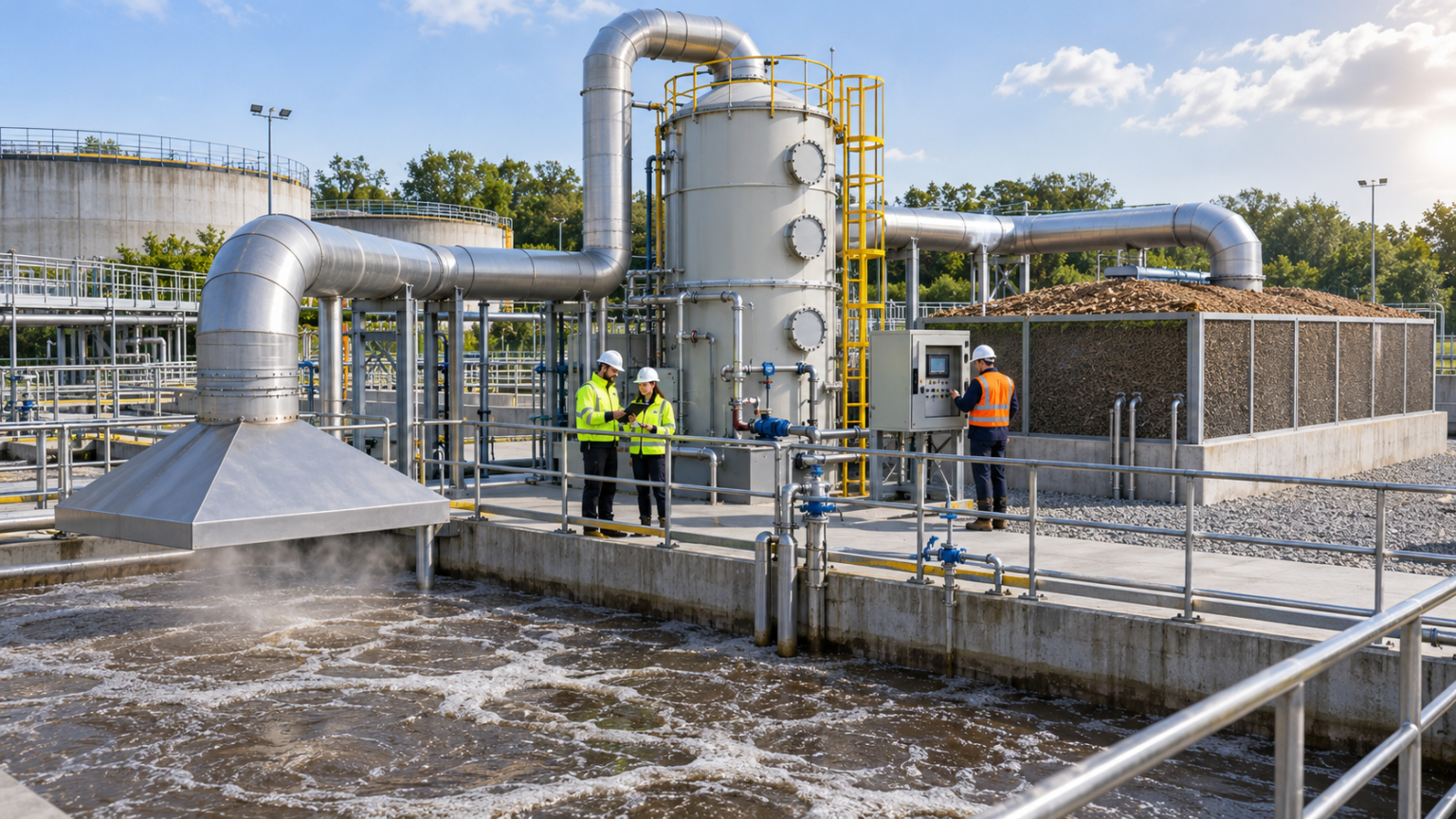

Unpleasant odors from wastewater treatment plants are more than an inconvenience for nearby communities. Hydrogen sulfide (H₂S), ammonia, and other airborne compounds can create environmental and workplace challenges. By combining effective ventilation, biological filtration, and industrial wet scrubbing technology, treatment facilities can reduce odor emissions, improve air quality, and support cleaner, safer operations.
Wastewater treatment plants play an essential role in protecting public health and the environment, but their operations can also generate unpleasant and potentially hazardous gases. Effective wastewater odor control requires more than temporarily reducing bad smells. It involves identifying emission sources, preventing gas formation, capturing contaminated air, and selecting appropriate industrial treatment technologies.
Modern facilities increasingly rely on wet scrubbers, biofilters, and integrated air purification systems to address hydrogen sulfide (H₂S) and other odor-causing compounds. These solutions help operators maintain better air quality, manage environmental responsibilities, and reduce the impact of treatment operations on surrounding communities.
Why Do Wastewater Treatment Plants Produce Unpleasant Odors?
Wastewater contains organic materials that begin to decompose as they move through sewer networks and treatment facilities. When oxygen becomes limited, anaerobic microorganisms break down these materials and can generate gases with strong, unpleasant odors.
One of the most significant compounds is hydrogen sulfide (H₂S), commonly recognized by its characteristic rotten-egg smell.
H₂S forms when sulfate-reducing bacteria operate in oxygen-depleted conditions. The gas can escape from wastewater during pumping, mixing, turbulence, and sludge processing.
Other compounds that contribute to wastewater odors include:
- Ammonia (NH₃): Produces a sharp, irritating smell, particularly in certain nitrogen-rich waste streams.
- Mercaptans: Sulfur-containing compounds that can create extremely strong odors, even at low concentrations.
- Volatile organic compounds (VOCs): Certain organic chemicals that contribute to complex industrial wastewater odors.
- Amines: Nitrogen-containing compounds associated with unpleasant fishy or ammonia-like smells.
- Volatile fatty acids: Compounds generated during organic decomposition that can create sour or rancid odors.
These substances may occur together, making odor management more complicated than removing a single gas.
For treatment plant operators, identifying the actual contaminants is an important first step toward selecting an effective solution.
Why Hydrogen Sulfide Control Is So Important
Hydrogen sulfide is a major concern in wastewater treatment because it presents several operational and environmental challenges.
1. Workplace Health and Safety
At elevated concentrations, H₂S can be dangerous to workers. Exposure may cause eye and respiratory irritation, while high concentrations can lead to severe health effects.
A particularly important safety concern is that workers cannot rely on smell to identify hazardous H₂S concentrations. Continuous or appropriate periodic gas monitoring, ventilation, and established safety procedures are essential.
2. Equipment Corrosion
Hydrogen sulfide can contribute to corrosion in wastewater infrastructure. Under suitable conditions, sulfur-oxidizing microorganisms can produce sulfuric acid, damaging concrete structures and certain metal components.
Over time, corrosion can increase maintenance requirements and shorten infrastructure service life.
3. Community Complaints
Even relatively low concentrations of odor-causing gases can affect nearby residents.
Persistent odors may create complaints, damage a facility’s reputation, and increase scrutiny from local environmental authorities.
4. Environmental Management
Poorly controlled emissions can make it more difficult for facilities to meet applicable air-quality and nuisance requirements.
For these reasons, odor control in wastewater treatment plants should be treated as an important part of operational planning rather than an optional improvement.
Where Do Most Wastewater Odor Emissions Originate?
Odor problems rarely affect every part of a treatment plant equally. Certain operations are more likely to generate or release gases.
Common emission sources include:
- Influent pumping stations: Wastewater arriving after extended periods in sewer pipelines may release accumulated H₂S.
- Screening and grit removal areas: Turbulence and agitation can allow dissolved gases to escape into the surrounding air.
- Primary sedimentation tanks: Organic matter and settled sludge can contribute to odor formation under unfavorable conditions.
- Equalization and holding tanks: Wastewater stored for long periods may become oxygen-depleted.
- Sludge thickening and dewatering facilities: Concentrated organic materials can release sulfur compounds and other unpleasant gases.
- Industrial wastewater storage areas: High-strength wastewater from industrial operations may contain elevated concentrations of odor-producing substances.
Understanding these sources allows operators to focus resources on the locations where treatment will provide the greatest benefit.
How Modern Wastewater Odor Control Systems Work
An effective industrial wastewater odor control system generally combines three strategies: preventing odor generation, collecting contaminated air, and treating the captured emissions.
Preventing Odors Before They Form
Reducing the formation of odor-producing compounds can decrease the load placed on air treatment equipment.
Depending on wastewater characteristics, prevention measures may include:
- Maintaining adequate oxygen levels where appropriate.
- Minimizing stagnant wastewater and excessive retention times.
- Removing accumulated sludge and organic deposits.
- Improving flow management in pumping and collection systems.
- Applying carefully engineered chemical treatment to control dissolved sulfides.
These approaches can reduce the severity of odor problems, but they may not eliminate airborne emissions entirely.
Capturing Contaminated Air
Treatment equipment can only remove pollutants effectively when the contaminated air reaches the system.
Industrial facilities often install covers, enclosures, ventilation hoods, extraction fans, and ductwork around major emission sources.
The collected air is then directed toward a dedicated treatment unit.
Proper enclosure design and airflow management help prevent odors from escaping before treatment.
Treating Odor-Causing Gases
Once contaminated air has been collected, it can be processed using technologies such as chemical wet scrubbing, biological filtration, or activated carbon adsorption.
The appropriate solution depends on the types of contaminants, their concentrations, the required airflow, and operational conditions.
Wet Scrubbers: An Effective Solution for H₂S and Industrial Odors
Wet scrubbers are widely used in industrial air pollution control because they can remove selected gaseous contaminants through contact with a liquid.
For wastewater applications, these systems can be engineered to address hydrogen sulfide and other odor-producing gases.
Manufacturers such as Torch-Air develop industrial wet scrubbing equipment designed for air purification and emission control across various industrial processes.
How Does a Wet Scrubber Work?
A typical packed-bed wet scrubber operates through the following process:
- Contaminated air enters the scrubber through a ventilation connection.
- The airflow passes through specially designed packing material.
- A circulating liquid flows over the packing, creating a large gas-liquid contact area.
- Target pollutants transfer from the gas into the liquid and may undergo chemical reactions.
- A mist eliminator helps remove entrained liquid droplets before the treated air is discharged.
For H₂S applications, alkaline solutions and suitable oxidizing chemistry may be used to improve removal performance.
The choice of liquid chemistry depends on the contaminants, process conditions, and environmental requirements.
Advantages of Wet Scrubber Systems
Properly engineered wet scrubbers can provide several important benefits:
- Effective gas removal: Suitable configurations can achieve high removal efficiencies for hydrogen sulfide and other targeted pollutants.
- Compact design: Certain scrubber configurations are practical for facilities with limited installation space.
- Adaptability: Chemical treatment conditions can be adjusted to accommodate changes in contaminant loading.
- Industrial durability: Corrosion-resistant construction materials can support operation in challenging environments.
- Integration flexibility: Scrubbers can be connected to existing ventilation and air extraction networks.
However, wet scrubbers also require attention to chemical consumption, liquid management, pumps, packing condition, and maintenance.
Facilities must properly manage the resulting treatment liquids and any associated waste streams.
Biofilters: A Biological Approach to Wastewater Odor Control
For facilities seeking biological treatment options, biofiltration offers another established method of odor reduction.
A wastewater odor control biofilter uses naturally occurring microorganisms to break down certain airborne pollutants.
Rather than relying primarily on chemical absorption, the process uses biological activity within a specially designed filter bed.
How Does Biological Filtration Work?
Contaminated air is passed through a bed containing materials that support microbial growth.
These materials may include wood-based media, compost-based mixtures, or specially engineered filtration media.
As polluted air passes through the filter, odor-causing compounds transfer into the moist biological layer.
Microorganisms then transform suitable pollutants through biological reactions.
For example, sulfur-oxidizing microorganisms can convert hydrogen sulfide into sulfate-containing products.
The system must be designed to manage the acidity that can develop during sulfur oxidation.
Benefits of Wastewater Biofilters
Biological filtration can offer several advantages:
- Reduced dependence on chemical scrubbing reagents.
- Suitable treatment for many continuous, biodegradable odor emissions.
- Potentially economical operation under favorable conditions.
- Flexibility to treat certain mixed odor streams.
- Compatibility with long-term environmental management strategies.
Biofilters are particularly attractive when contaminant levels and airflow conditions remain relatively stable.
However, biological systems need appropriate moisture, temperature, pH, airflow distribution, and maintenance.
Sudden contaminant spikes or unsuitable operating conditions may reduce biological treatment performance.
For this reason, biofilters should be selected and designed according to the actual wastewater facility requirements.
Wet Scrubbers vs. Biofilters: Which Technology Is Better?
When evaluating wastewater odor control technologies, there is no single solution that performs best in every situation.
Wet scrubbers and biological filters address similar environmental problems but operate through different mechanisms.
Wet Scrubbers Are Often Suitable When:
- H₂S concentrations are relatively high or fluctuate significantly.
- Installation space is limited.
- Rapid response to changing gas loads is important.
- Chemical handling and liquid treatment facilities are available.
- Target contaminants can be efficiently removed through selected scrubbing chemistry.
Biofilters Are Often Suitable When:
- Odor emissions are relatively steady.
- Pollutants are compatible with biological treatment.
- Adequate installation space is available.
- Operators want to minimize routine chemical reagent use.
- Conditions can support a healthy microbial population.
In some applications, combining different technologies provides a more balanced result.
For example, a scrubber may handle a concentrated gas stream, while a downstream biological or adsorption stage treats remaining odor compounds.
The best configuration depends on engineering evaluation rather than technology preference alone.
The Role of Activated Carbon and Hybrid Odor Control Systems
Although wet scrubbers and biofilters are important technologies, certain wastewater facilities also use activated carbon filtration.
Activated carbon works through adsorption, where pollutant molecules are retained on the surface of porous media.
Specially selected or treated carbon materials can be used for certain sulfur compounds and other odor-producing gases.
Activated carbon systems may be particularly useful for:
- Relatively low contaminant concentrations.
- Final polishing after another treatment stage.
- Intermittent emissions.
- Applications requiring compact equipment.
The main operating consideration is that adsorption media eventually becomes exhausted and must be replaced or regenerated where appropriate.
Hybrid wastewater odor control systems combine complementary technologies to address different contaminants or operating conditions.
For example, a facility may use a wet scrubber for primary H₂S removal and an activated carbon unit for residual odors.
This approach can be useful when both high pollutant loading and stringent outlet requirements must be considered.
How to Choose the Right Industrial Wastewater Odor Control System
Selecting effective equipment requires more than comparing advertised removal efficiencies.
Plant managers and engineers should evaluate the complete emission profile before investing in a treatment system.
Important Selection Factors
1. Hydrogen Sulfide Concentration
Both average and peak H₂S concentrations should be considered. A system designed around average conditions alone may struggle during unexpected emission peaks.
2. Airflow Volume
The total contaminated air volume influences equipment size, energy consumption, and treatment capacity.
3. Additional Odor Compounds
Some facilities experience mixed emissions involving ammonia, mercaptans, and organic compounds. These may require different or multiple treatment processes.
4. Available Installation Space
Compact wet scrubbers may suit restricted industrial locations, while conventional biofilters can require larger treatment areas.
5. Operating and Maintenance Costs
Equipment purchase price is only one component of the total investment. Electricity, chemicals, water, replacement media, maintenance, and waste handling must also be considered.
6. Environmental Requirements
Designers must account for applicable emission requirements, odor nuisance regulations, worker safety rules, and wastewater discharge conditions.
7. Future Capacity
Treatment facilities may expand or experience changing wastewater characteristics. A flexible design can make future modifications easier.
A comprehensive evaluation helps prevent underperforming installations and unnecessary operating costs.
Why Professional System Design Matters
Industrial wastewater odor control systems must function reliably under demanding conditions.
For this reason, equipment selection should begin with a thorough site assessment.
A practical engineering process typically includes:
- Identifying and mapping major emission sources.
- Measuring H₂S concentrations and other relevant contaminants.
- Determining average and maximum airflow requirements.
- Reviewing wastewater composition and seasonal variations.
- Selecting suitable air collection and treatment technologies.
- Evaluating corrosion resistance and construction materials.
- Planning monitoring, inspection, and maintenance requirements.
Experienced industrial air purification equipment manufacturers can support this process by helping facilities understand available treatment configurations.
Torch-Air, for example, provides industrial air-cleaning technologies, including wet scrubbing solutions and biological odor-control equipment, that can be considered when developing an appropriate emission management strategy.
The objective is not simply to install the largest possible treatment unit. It is to match the technology to the actual pollution problem.
Maintaining Reliable Odor Control Performance
Even a well-designed system needs consistent operation and maintenance.
Without regular monitoring, equipment performance can gradually decline, allowing unpleasant odors to return.
Recommended Maintenance Practices
- Monitor gas concentrations: Measure inlet and outlet H₂S levels to evaluate treatment performance.
- Inspect ventilation equipment: Ensure extraction fans, ductwork, and enclosures remain functional.
- Maintain wet scrubber chemistry: Monitor applicable liquid parameters, chemical feed, and circulation systems.
- Check biological filter conditions: Maintain appropriate moisture, pH, and airflow through the filter media.
- Inspect pressure drop: Unusual changes may indicate blockages, fouling, or airflow problems.
- Maintain records: Document operating conditions, inspections, corrective actions, and odor complaints.
Regular assessment allows operators to identify developing problems before they lead to significant performance losses.
Environmental Benefits of Effective Wastewater Odor Control
Properly managed odor emissions can contribute to a more sustainable wastewater treatment operation.
The benefits extend beyond eliminating an unpleasant smell.
Improved Local Air Quality
Capturing and treating odorous gases helps reduce the release of selected contaminants into the surrounding environment.
Better Community Relations
Lower odor emissions can reduce nuisance complaints and improve the relationship between treatment facilities and nearby residents.
Stronger Workplace Protection
Appropriate gas detection, ventilation, and emission control can support safer industrial working conditions.
Reduced Corrosion-Related Damage
Managing H₂S formation and emissions may help reduce corrosion risks in susceptible infrastructure.
More Responsible Industrial Operations
Well-designed wastewater odor control systems allow facilities to manage atmospheric emissions as part of their wider environmental performance.
Nevertheless, environmental benefits should be assessed alongside water use, energy consumption, chemical handling, and waste generation to ensure the complete system remains sustainable.
Frequently Asked Questions
What Is the Main Cause of Odor in Wastewater Treatment Plants?
Hydrogen sulfide is one of the most recognizable odor-causing gases. It commonly develops when microorganisms break down sulfur-containing compounds under oxygen-depleted conditions. Ammonia, mercaptans, and other volatile compounds can also contribute.
Can Wet Scrubbers Remove Hydrogen Sulfide?
Yes. Properly designed wet scrubbers can remove H₂S from contaminated air using suitable gas-liquid contact and treatment chemistry. Actual removal efficiency depends on concentration, airflow, equipment design, and operating conditions.
Are Biofilters Suitable for Industrial Wastewater Odor Control?
Yes. Biological filtration can effectively treat suitable biodegradable odor compounds, particularly when emissions are relatively stable and the system is maintained under appropriate conditions.
Is a Wet Scrubber or Biofilter More Cost-Effective?
The answer depends on contaminant loading, airflow, installation space, chemical consumption, maintenance needs, and expected equipment life. A site-specific technical and economic comparison is necessary.
How Can Treatment Plants Reduce Odor Complaints?
Facilities can reduce complaints by controlling sulfide formation, enclosing major emission sources, installing suitable industrial air treatment equipment, and monitoring treatment performance consistently.
Conclusion: Building a Cleaner Future for Wastewater Treatment
Wastewater odor management is an essential part of operating modern treatment facilities responsibly. Hydrogen sulfide and other odor-causing compounds can affect air quality, infrastructure, worker safety, and relationships with surrounding communities.
Fortunately, modern industrial wastewater odor control systems provide several effective ways to address these challenges.
Wet scrubbers offer flexible chemical treatment for selected gaseous contaminants, while biofilters provide a biological approach for suitable odor emissions. Activated carbon and hybrid systems can deliver additional treatment where required.
The most successful approach combines source prevention, effective air capture, appropriate equipment selection, and ongoing maintenance.
With properly engineered industrial air purification solutions from manufacturers such as Torch-Air, wastewater treatment operators can develop practical strategies to reduce odor emissions and support cleaner, more reliable operations.
