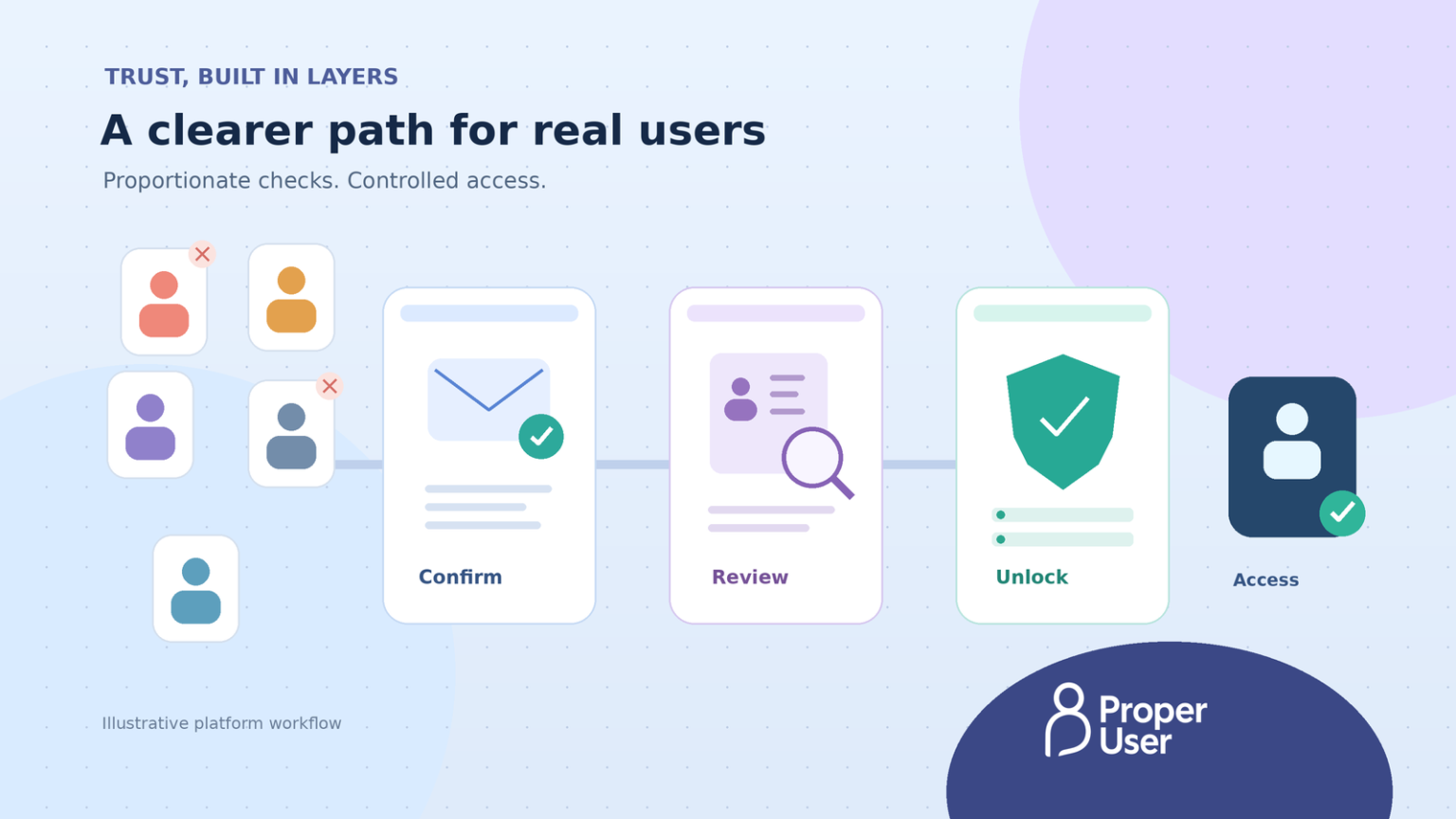

A fake account can look ordinary until it starts sending spam, claiming repeated trials or impersonating a seller. For SaaS companies, marketplaces, creator platforms and subscription services, prevention works best as a series of proportionate checks, with stronger evidence required when an account gains more power.
Start with the behaviour you need to prevent
Imagine a subscription service celebrating a surge in registrations. A week later, support discovers that many accounts exist only to collect introductory benefits. The registration form worked exactly as designed; the access rules made abuse worthwhile.
Before buying another tool, name the problem. Is it automated signup, impersonation, repeated promotions, fraudulent seller profiles or banned users returning? These behaviours overlap, but they need different responses. A second account might also be legitimate: a consultant managing separate clients is not automatically a fraudster.
Define what each account may do before and after checks. Browsing a catalogue, inviting colleagues, publishing a listing and receiving payouts should not necessarily have identical requirements. Where age restrictions apply, complete the necessary age check before granting restricted access.
Confirm contact details without mistaking them for identity
Email confirmation establishes that someone can access an inbox. Phone confirmation establishes access to a number at that moment. Neither proves a legal identity, good intentions or that the person has only one account.
Use confirmation links or codes with limited validity and single use. Apply resend and attempt limits, and enforce confirmation on the server before unlocking the relevant features. Sending an email without restricting an unconfirmed account leaves the useful part of the control unfinished.
Make recovery straightforward when a genuine customer mistypes an address. Treat disposable email providers and unusual phone patterns as signals to investigate rather than universal reasons to reject someone. Additional checks should answer a specific concern, not simply make signup longer.
Look for patterns across registrations
One quick registration says little. Many registrations sharing unusual timing, repeated profile details and the same promotional behaviour deserve attention. Compare activity over time rather than relying on one field that an attacker can easily replace.
Useful signals include bursts from related sessions or devices, repeated verification failures and new accounts immediately attempting identical actions. Combine registration signals with what happens next. A cluster that promptly sends the same message is more informative than a cluster that quietly explores the product.
Set limits at several levels, including the signup endpoint, network source and session where appropriate. Enforce equivalent rules on mobile and other registration routes. Otherwise, restrictions on the visible website can leave another entrance open.
Shared office networks, student housing and mobile carriers can put unrelated people behind one address. Privacy tools can also change network signals. Use combinations of evidence, review uncertain cases and avoid making a shared IP address an automatic ban.
Ask for identity evidence where the risk justifies it
Risk-based onboarding means choosing checks according to the action and potential harm. A marketplace visitor saving favourites may need less evidence than a seller requesting access to higher-risk features. A creator platform may need identity and adult-age checks before enabling particular activity.
A user verification platform can support the identity-evidence layer. ProperUser, for example, describes an embedded process in which users confirm personal details, complete declarations and an electronic signature, then submit an identity document and a required selfie holding that document and dated paper.
Submission enters review; it is not approval. Users can see a pending outcome or reasons that corrections are needed, and the connected platform receives verification-status updates. The platform must decide which permissions those states unlock and keep restricted actions unavailable while a required check remains pending.
Identity review does not replace spam controls, account authentication or ongoing moderation. Nor should teams assume a verification provider automatically detects duplicate accounts or prevents every form of fraud. Confirm the actual scope before designing dependencies around it.
Protect the account after the first check
A genuine person can pass onboarding and later lose control of their account. That is account takeover rather than fake registration, but the compromised profile may be used for similar abuse.
Build secure user authentication around appropriate login protections, such as passkeys or multifactor authentication, controls against repeated attempts and careful account recovery. Reauthentication is especially useful before sensitive changes, including replacing a payout destination or changing recovery details.
Keep identity verification, authentication and authorisation distinct. Identity checks assess evidence about a person. Authentication checks control of an account credential. Authorisation determines what the signed-in account may do. Passing one check should not silently grant every permission.
Make repeat abuse less rewarding
Deleting a spam profile helps little if its replacement can immediately send another thousand messages. Reduce the value available to an untrusted new account: introduce sensible messaging limits, staged publishing privileges or checks before promotional rewards are released.
When investigating repeat abuse, compare relevant evidence across incidents within a defined privacy and retention policy. Do not assume that matching contact details, devices or payment references always identify the same individual. Shared households and teams need a route to explain legitimate overlap.
Record why an account was restricted and what would justify restoring access. Give reviewers enough context to distinguish a corrected mistake from persistent abuse. A clear appeal process also reveals rules that are catching too many genuine customers.
Keep the legitimate journey understandable
Explain why a check is needed before asking for it. State what information is required, what happens after submission and how users can correct an error. Accessible forms and useful upload guidance often remove friction more effectively than promising an unrealistically instant result.
When discussing a secure onboarding solution with a provider, bring the actual user journey: which roles require checks, when access must pause and who handles corrections. Ask about data access, retention, supported languages and the boundaries between provider review and your own platform decisions.
Measure completed legitimate registrations alongside confirmed abuse, review workload and successful appeals. A fall in signups alone is not proof of better protection. Start with the abuse causing real harm, introduce a targeted layer and check whether it improves that balance.
For a SaaS trial, that might mean confirming the work email before invitations are enabled, limiting early invitations and reviewing clusters that repeatedly claim the same benefit. It does not automatically mean asking every reader of a product tutorial for a passport.
For a marketplace, the important boundary might be publishing the first listing. Explain the seller requirements upfront, keep incomplete profiles out of public results and show a clear status while any required evidence is reviewed. Buyers browsing ordinary listings can follow a different path. These are design examples, not claims about a provider’s built-in features; each platform needs to implement and test its own access rules, including what happens when a review is delayed or an account changes role.
The aim is to make dishonest activity harder without treating every newcomer as a suspect. Contact confirmation, contextual signals, proportionate identity review and controlled permissions work together; none needs to carry the entire burden alone.
