
The record player arrives, you unbox it carefully, connect it to your amplifier or powered speakers the way you would connect anything else, drop the needle on a favourite album — and the sound that comes out is a disappointment. Quiet, even with the volume far higher than usual. Thin, with almost no bass. A little scratchy around the edges. Your first suspicion is a faulty turntable or a worn record, but in most first setups nothing is broken. The signal from the cartridge is simply not the kind of signal the rest of your system was expecting, and one missing stage explains every symptom at once.
What the Cartridge Actually Produces
A turntable cartridge is a tiny generator. As the stylus rides the groove, it converts those wiggles into an electrical signal measured in millivolts — roughly a hundred times weaker than the output of a phone, a streamer, or a CD player. Plug that whisper straight into a normal amplifier input and the amplifier does its honest best with almost nothing, which is why you end up at three o’clock on the volume knob hearing a faint, hissy version of your record. The weakness is not a defect. It is the physics of how records work, and every vinyl system ever built has included something to deal with it.
The Second Problem: Records Are Deliberately Unequalised
Weakness is only half the story. When a record is cut, its bass is deliberately reduced and its treble boosted, following a standard curve called RIAA equalisation. This is done for practical reasons: full-strength bass would make the groove swing so widely that tracks could not fit side by side, and surface noise would be far more obvious. Playback has to apply the exact mirror image of that curve — bass restored, treble tamed — or the record sounds exactly as new owners describe it: thin, bright, and wrong. That mirror-image correction, plus the large boost in volume, is the entire job description of the phono stage.
Where the Phono Stage Can Live
- Built into the turntable: many starter models have a switchable phono/line switch on the back. Set to ‘phono’, the deck expects an external stage or a phono input; set to ‘line’, its own stage is active and it can feed any input.
- Built into the amplifier: an input labelled PHONO has the stage behind it. Never plug a turntable’s line-level output into it, or you will equalise twice and hear bloated, distorted bass.
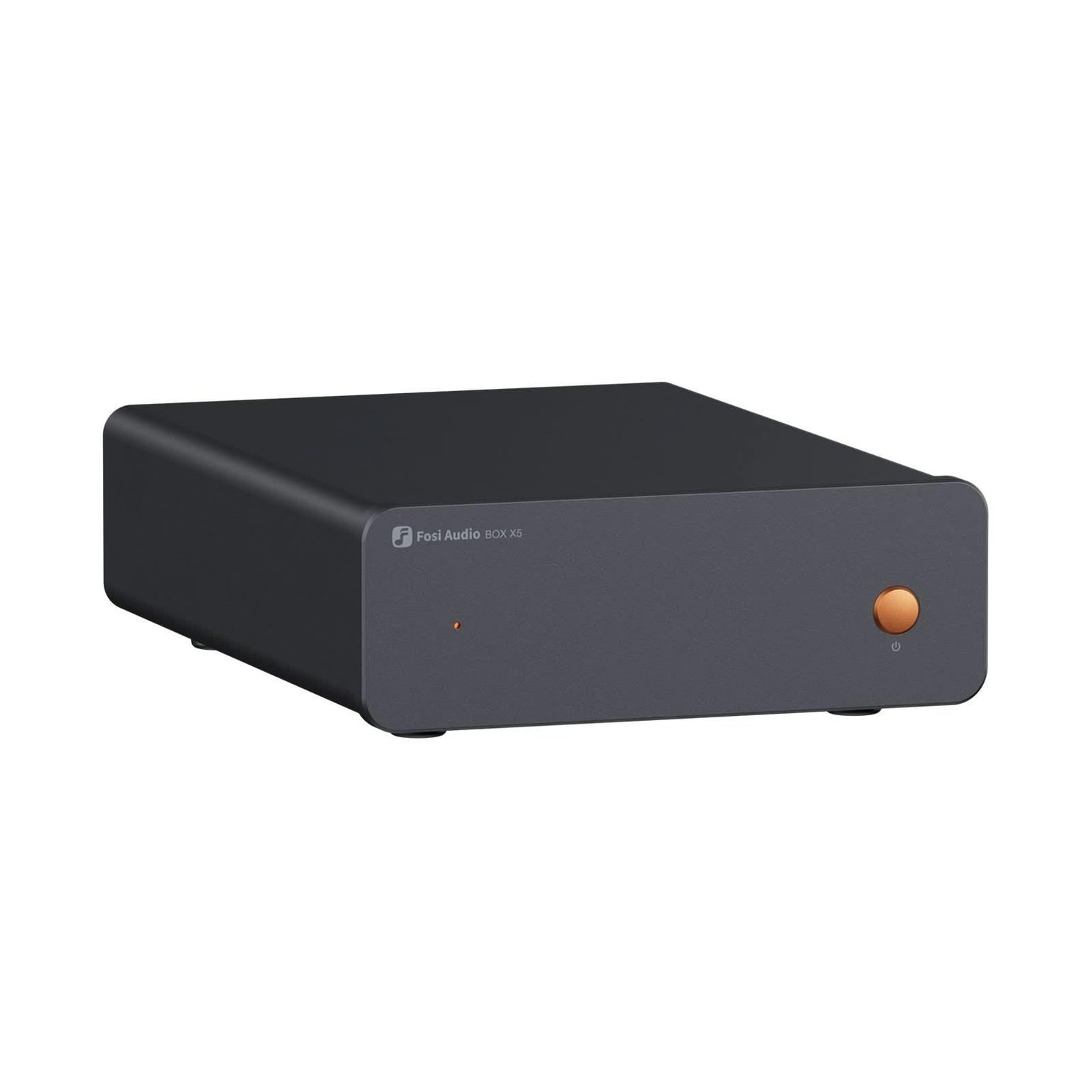
- In a separate box: a standalone phono preamp for turntable use sits between deck and amplifier, feeding any ordinary line input. This is the flexible option when neither the turntable nor the amplifier has one built in — and a common first upgrade later.
The beginner’s rule is simple: the signal must pass through exactly one phono stage on its way to the speakers. None gives you the quiet, thin sound. Two give you a loud, muddy mess. Most first-setup problems are one of those two, and both are fixed by checking switches and input labels rather than buying anything.
Setting Up, Step by Step
- Connect the turntable’s RCA cables to the phono preamp’s input (or the amplifier’s PHONO input), then run a second RCA pair from there to a line input if you are using a separate box.
- Set the switches to match your cartridge. Almost every starter turntable uses a moving magnet (MM) cartridge, so choose MM. Moving coil settings are for a different, much quieter cartridge family you are unlikely to meet in a first system.
- Attach the thin ground wire — the step beginners skip, covered below.
- Start with the volume low, play a record you know, and bring the level up. The sound should now sit at a volume comparable to your other sources, with the bass back where the recording put it.
The Ground Wire and the Hum It Prevents
Trailing from most turntables, alongside the RCA leads, is a thin wire ending in a small spade connector. This is the ground wire, and leaving it dangling is the second most common beginner mistake after the missing phono stage. Without it, the system usually hums — a steady low buzz through the speakers that gets louder with the volume and has driven many new owners to re-box a perfectly good turntable. The fix takes ten seconds: loosen the knurled ground terminal (marked GND) on the back of the phono preamp for turntable setups or on the amplifier, slip the spade underneath, and tighten it. The hum should vanish or drop to near silence. If a faint hum remains, check that the RCA plugs are pushed fully home and that the turntable’s power supply is not sitting directly on top of the preamp.
How You Will Know It Is Right
A correctly set up first system has a few easy tells. Records play at roughly the same volume-knob position as streaming. Bass sounds like part of the music rather than a rumour. Quiet passages are quiet, not buried in hiss from an amplifier straining at full gain. And switching between sources no longer means lunging for the volume control. Get a phono preamp for turntable use in place — exactly one — with the cartridge type set to MM and the ground wire landed, and a first turntable stops sounding like a problem to solve. It just sounds like records — which is what you bought it for in the first place.
