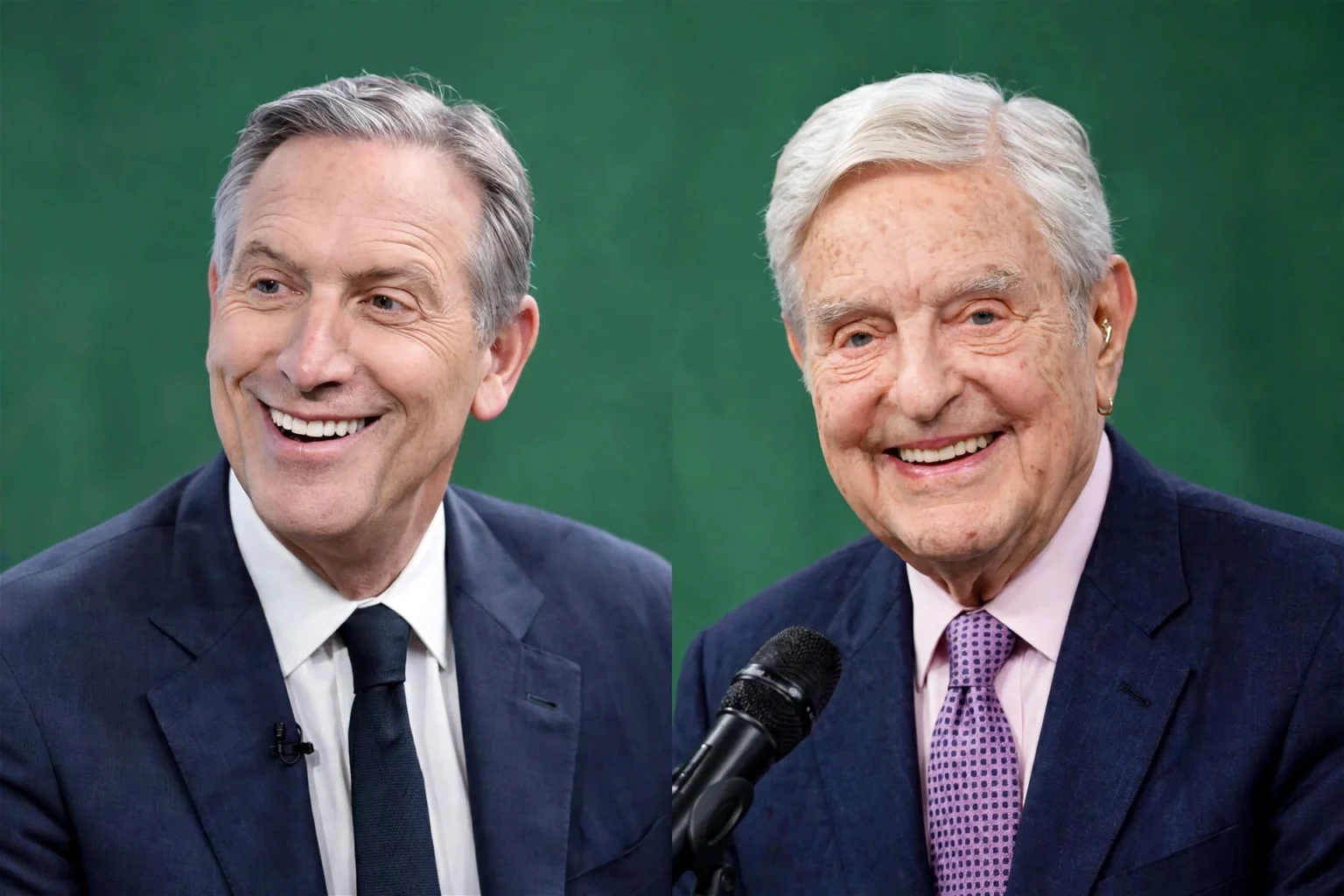

Howard Schultz and George Soros have a documented indirect political connection: Soros donated to American Bridge 21st Century, an organisation that filed a complaint about Schultz’s potential presidential campaign in 2019. That connection does not establish a personal friendship, business partnership or direct action by Soros against Schultz.
The distinction becomes clearer when the donation history, the complaint and its eventual dismissal are considered separately.
Who are Howard Schultz and George Soros?
Howard Schultz is the businessman associated with Starbucks’ development into an international coffeehouse company. However, he did not establish the original Starbucks business in 1971. Its founders were Gerald Baldwin, Gordon Bowker and Zev Siegl, according to Starbucks’ company history.
Schultz subsequently developed a different vision for the business, centred on Italian-style coffee bars. Starbucks records that he left the company in 1985 to start Il Giornale. In 1987, Il Giornale acquired Starbucks’ assets, including its name, roasting plant and six Seattle stores, and adopted the Starbucks name.
George Soros built his career in finance. His official biography identifies 1970 as the year he launched Soros Fund Management. He later used his wealth to develop the philanthropic network known as the Open Society Foundations.
According to the foundations, Soros began his philanthropy in 1979 by providing scholarships to Black South Africans living under apartheid. Its work subsequently expanded internationally, supporting causes including human rights, justice and democratic governance.
Their professional histories therefore concern different fields: Schultz’s central business association is coffee retailing, while Soros’s is investment management.
How does American Bridge connect them?
American Bridge 21st Century is a political organisation that conducts opposition research to support Democratic candidates and organisations. In an April 2018 profile, FactCheck.org reported that Soros was its largest donor during the 2016 election cycle, contributing $2 million.
That donation predates the complaint about Schultz. It establishes Soros’s financial support for the organisation, but does not establish that the money was earmarked for work involving Schultz.
In January 2019, Schultz publicly discussed seeking the US presidency as a centrist independent in the 2020 election. His possible candidacy attracted criticism from Democrats who feared an independent campaign could help Donald Trump win re-election.
American Bridge’s subsequent complaint concerned whether Schultz’s preparations had crossed the boundary between exploring a campaign and becoming a candidate subject to federal registration and reporting requirements. It was a dispute about campaign disclosure, rather than evidence of a business relationship between Schultz and Soros.
What did the complaint allege?
The complaint in FEC matter MUR 7567 argued that Schultz had gone beyond merely assessing whether to run for president. It cited reporting about political consultants, polling and preparations for paid advertising.
American Bridge asked the Federal Election Commission to investigate whether those activities required Schultz to register as a candidate and disclose campaign spending.
Schultz disputed that interpretation. In an April 12, 2019 response submitted by his lawyers, he maintained that he was still evaluating a possible run and had not decided to become a candidate. His response also argued that polling and consultants could be part of permissible exploratory activity.
These were opposing positions in a complaint process. Filing the complaint did not establish that Schultz had violated campaign-finance requirements.
The FEC identifies the complainants as American Bridge 21st Century, subsequently named AB PAC, and Bradley Beychok. It does not identify George Soros as a complainant.
What happened to Schultz’s presidential plans and the FEC case?
On September 6, 2019, Schultz announced that he would not pursue an independent presidential campaign. ABC News reported that his explanation included concerns about the electoral consequences of running as an independent.
The FEC later voted unanimously, 6–0, to dismiss the allegation and close the file. Its public case record documents that outcome.
There is a further distinction in the record: commissioners agreed on dismissal but did not adopt a single factual and legal analysis explaining their decision. Separate statements of reasons were published. The established outcome is therefore the dismissal itself; one group of commissioners’ explanation should not be presented as a rationale formally adopted by the entire commission.
Does this establish a personal relationship?
The American Bridge episode establishes an institutional link between the two men. Soros supported a political organisation, and that organisation later challenged Schultz’s campaign-related activities.
The cited records do not establish that Soros directed the complaint, personally investigated Schultz or caused him to abandon his presidential plans. They also do not establish a family relationship, friendship or joint business venture.
Describing the episode as “Soros filing a complaint against Schultz” would obscure who actually filed it. The accurate account keeps the participants and events distinct: Soros was a donor, American Bridge and Beychok were the complainants, Schultz was the respondent, and the FEC dismissed the allegation.
Sources
Factual sources
| Publisher | Page title and direct URL | Publication or document date |
|---|---|---|
| Starbucks | Our Founders | Not displayed |
| Starbucks | Il Giornale | Not displayed |
| George Soros’s official website | The Life of George Soros | Not displayed |
| Open Society Foundations | George Soros | Not displayed |
| FactCheck.org | American Bridge 21st Century | April 20, 2018 |
| Federal Election Commission | MUR 7567: Complaint | 2019 |
| Federal Election Commission | MUR 7567: Response from Howard Schultz | April 12, 2019 |
| ABC News | Former Starbucks CEO Howard Schultz formally announces he won’t run in 2020 | September 6, 2019 |
| Federal Election Commission | MUR #7567 | Page date not displayed |
| Federal Election Commission | Statement of Reasons: Chair Shana M. Broussard and Commissioner Ellen L. Weintraub | December 15, 2021 |
