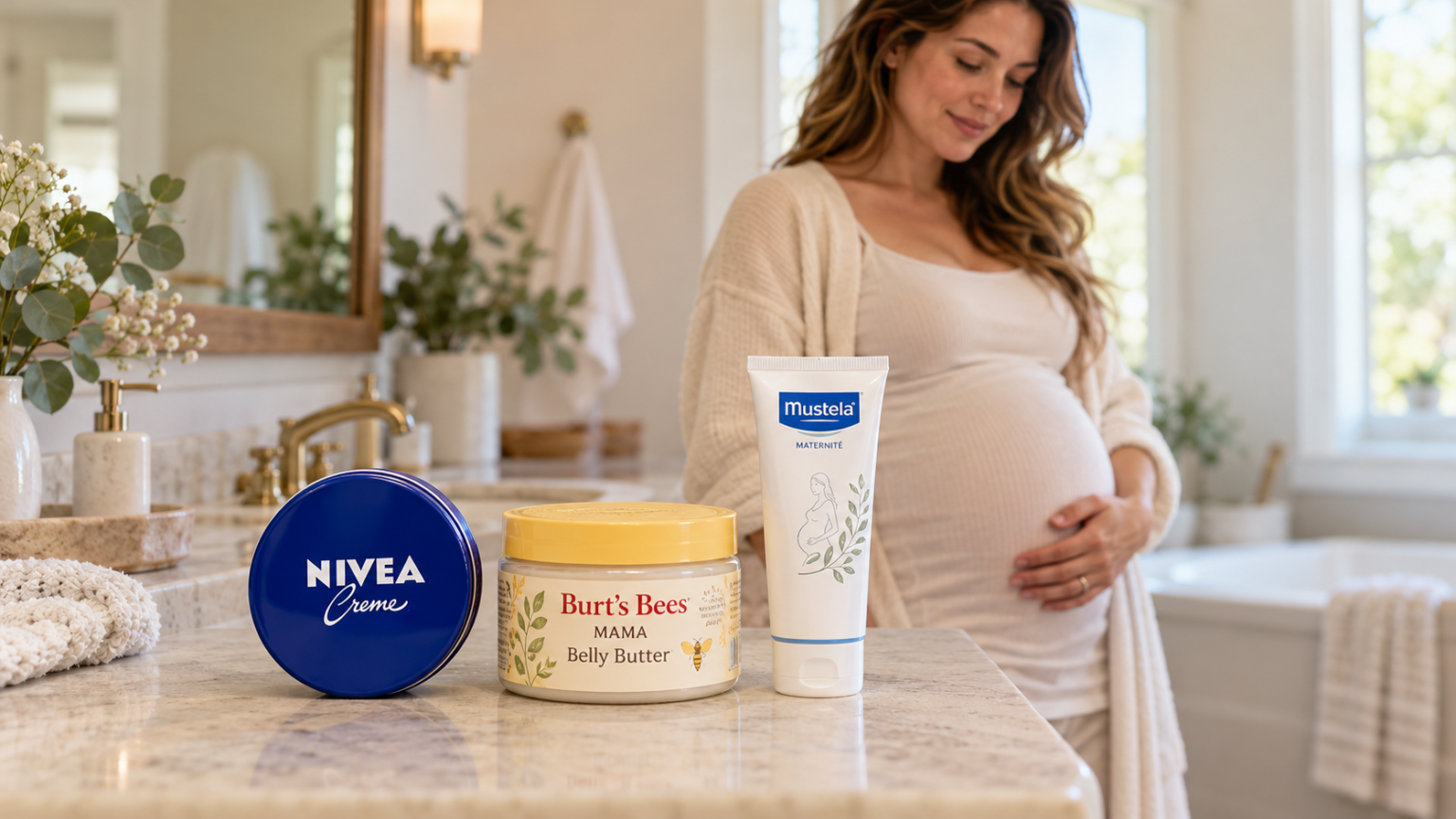

Pregnancy can turn an ordinary moisturizer purchase into a label-reading exercise. A basic Nivea moisturizer can be a reasonable option during pregnancy, but the specific formula matters more than the brand name. Burt’s Bees and Mustela also offer products worth considering, especially when you prefer a formula without added fragrance. However, the medical guidance and product information reviewed do not establish that either brand is safer than Nivea for a developing baby. The useful comparison is between individual products: their ingredients, intended use, and suitability for your skin.
Compare the Product, Not Just the Brand
Nivea, Burt’s Bees, and Mustela each sell different types of skin care. A recommendation about one body cream cannot automatically extend to every facial treatment, sunscreen, or acne product bearing the same logo.
Three questions help make the decision clearer:
- Does it contain an ingredient that should be avoided during pregnancy?
- Could it irritate your skin or trigger a known allergy?
- Does it provide the benefit you need without unnecessary treatments?
Pregnancy safety and skin tolerance are separate issues. A moisturizer may contain no obvious pregnancy-related ingredients of concern and still cause a rash. Likewise, choosing fragrance-free skin care can help reduce exposure to potential irritants without proving that every scented product poses a risk to a fetus.
Here is how three specific products compare based on their official U.S. ingredient listings.
| Product | Selected listed ingredients | Fragrance information | Practical consideration |
|---|---|---|---|
| Nivea Creme | Mineral oil, petrolatum, glycerin, lanolin alcohol, panthenol | Lists fragrance | A rich moisturizer; less suitable if you need to avoid fragrance |
| Burt’s Bees Mama Belly Butter | Sunflower oil, glycerin, coconut oil, shea butter, sweet almond oil, cocoa butter | No fragrance or parfum listed | An option for belly moisturizing; check its plant ingredients against known allergies |
| Mustela Stretch Marks Cream Fragrance-Free | Glycerin, shea butter, avocado oil, hydrolyzed avocado protein | Explicitly fragrance-free | An option for people seeking a fragrance-free maternity cream |
None of these three posted ingredient lists includes retinol, tretinoin, adapalene, or hydroquinone. That is an ingredient-screening observation, not a guarantee of safety for every person. Check the packaging you purchase because online information and the product in your hands may differ.
Is Nivea Creme Safe During Pregnancy?
The U.S. Nivea Creme formula reviewed is a moisturizer built around ingredients such as mineral oil, petrolatum, and glycerin. It is not presented as a retinoid treatment or a skin-lightening medication.
For someone who needs help with dry skin and tolerates the formula, pregnancy alone is not a reason to assume it must be replaced with a maternity-branded cream.
Its most relevant distinction in this comparison is added fragrance. If scented products sting, worsen an existing skin condition, or become unpleasant during pregnancy, a fragrance-free alternative may be more comfortable.
This assessment applies to Nivea Creme’s reviewed formula. Other Nivea products require their own ingredient checks, particularly those marketed for acne, dark spots, exfoliation, or anti-aging.
How Burt’s Bees and Mustela Compare
Burt’s Bees Mama Belly Butter
Burt’s Bees describes Mama Belly Butter as a moisturizer for use during and after pregnancy. Its posted ingredients include glycerin, sunflower oil, coconut oil, and several plant butters. Fragrance is not listed.
That makes it a product to consider when you want belly moisturization without added perfume. However, “natural” ingredients do not automatically make a product safer or suitable for sensitive skin.
If you have a known allergy to an ingredient, avoid that ingredient regardless of the brand’s pregnancy-oriented packaging.
Mustela Stretch Marks Cream Fragrance-Free
Mustela explicitly markets this cream for pregnancy and postpartum use. The company states that it is tested under dermatological and gynecological supervision. Its listed formula includes glycerin, shea butter, and avocado-derived ingredients.
Those details help explain the product’s intended use. They do not establish that it offers better fetal safety than the other moisturizers.
Mustela’s fragrance-free designation is useful if avoiding fragrance is your priority. Its stretch-mark claims, however, require a separate assessment from its role as a moisturizer.
Which Skin-Care Ingredients Need Extra Attention?
The American Academy of Dermatology recommends avoiding retinoids and hydroquinone during pregnancy. Retinoids include retinol in cosmetic products and medications such as tretinoin and adapalene.
Check treatments as carefully as moisturizers. An anti-aging serum or dark-spot cream may raise different questions from a basic body lotion.
Do not assume that every acid is prohibited. MotherToBaby summarizes American College of Obstetricians and Gynecologists guidance allowing certain over-the-counter acne ingredients when needed, including:
- Azelaic acid
- Benzoyl peroxide
- Salicylic acid
- Glycolic acid
Concentration, application area, frequency, and other ingredients still matter. The AAD advises discussing salicylic acid above 2% and limiting certain treatments during pregnancy. A strong peel should not be treated as equivalent to a routine acne product.
MotherToBaby also explains that absorption of topical acne medication can increase when it is applied frequently, over large areas, or to broken or irritated skin. Bring treatment products to your prenatal appointment rather than relying on a brand-wide “safe” list.
“Natural” and “Pregnancy-Safe” Labels Have Limits
Burt’s Bees and Mustela emphasize ingredients of natural origin, but ingredient origin does not determine safety. The FDA explains that plants can contain substances that are toxic or allergenic, whether organically grown or not.
Similarly, maternity branding is not evidence of a separate FDA pregnancy-safety approval. Most cosmetic products and ingredients do not require FDA approval before sale, although certain color additives do. Manufacturers remain responsible for ensuring their products are safe under labeled or customary use.
For shoppers, the implication is straightforward: use the ingredient list and directions to evaluate a product, and treat marketing claims as additional information.
What About Preventing Stretch Marks?
A belly cream’s ability to moisturize should not be confused with proof that it prevents stretch marks.
The AAD explains that stretch marks are scars associated with rapid stretching or shrinking of the skin. Hormonal changes and family history can influence whether they develop. Its review notes that cocoa butter, almond oil, olive oil, and vitamin E did not prevent stretch marks in studies.
Mustela’s product page cites a four-week study involving 64 pregnant women, with its appearance-related result based on participant self-evaluation. That finding should not be interpreted as a guarantee that the cream prevents stretch marks throughout pregnancy.
Choose a belly moisturizer for comfort and manageable dryness. Paying more for a stretch-mark claim does not guarantee a different outcome.
A Simple Way to Choose
Start with the product’s job: moisturizing, cleansing, sun protection, or treating a condition. Then check its complete ingredients and instructions.
For a new moisturizer, the AAD recommends testing a small area twice daily for seven to 10 days before wider use. Stop if a reaction develops. This checks skin tolerance; it does not establish pregnancy safety.
Keep sun protection in your routine. The AAD recommends broad-spectrum, water-resistant SPF 30 or higher and suggests zinc oxide or titanium dioxide sunscreen during pregnancy to help avoid irritation.
A photo of the exact label can make a discussion with your obstetrician or dermatologist much more useful than asking whether an entire brand is safe.
Frequently Asked Questions
Can I apply Nivea Creme to my pregnant belly?
The reviewed U.S. formula is intended for body moisturizing and does not list retinoids or hydroquinone. It may be a reasonable choice for dry, intact skin if you tolerate its ingredients and fragrance. Follow the label and seek individualized advice if you have a skin condition.
Are Mustela baby products automatically appropriate for pregnant adults?
Baby branding does not replace an ingredient review. Evaluate the particular product, its intended use, and any warnings. Mustela’s maternity products and baby products should not be treated as interchangeable.
Should I stop every product containing salicylic acid?
Not automatically. ACOG guidance, summarized by MotherToBaby, permits topical salicylic acid when needed. Ask your clinician about the concentration and how you use it, especially for strong peels or applications over large areas.
What if itching continues after I change moisturizers?
Contact your prenatal care provider, particularly for persistent itching without a rash. MedlinePlus warns that this can signal cholestasis, a pregnancy condition that requires medical assessment. Repeatedly changing lotions is not an adequate response to unexplained persistent itching.
Choosing With Confidence
There is no evidence-based brand winner in this comparison. Choose the exact formula that fits your needs, avoids ingredients your clinician advises against, and agrees with your skin. A familiar moisturizer may be sufficient; a fragrance-free alternative may be more comfortable.
Sources
- American Academy of Dermatology — pregnancy skin-care guidance: ingredients to avoid, treatment precautions, and sun protection. Read the guidance.
- MotherToBaby — topical acne treatments: pregnancy guidance and factors affecting absorption. Read the fact sheet.
- Nivea USA — Nivea Creme: official product information and ingredient list. View the product.
- Burt’s Bees — Mama Belly Butter: official ingredients and intended use. View the product.
- Mustela USA — Stretch Marks Cream Fragrance-Free: official ingredients, testing claims, and study description. View the product.
- FDA — cosmetics and pregnancy; organic cosmetics: regulatory responsibilities and the limits of ingredient-origin claims. Pregnancy guidance and organic cosmetics guidance.
- American Academy of Dermatology — stretch marks: evidence on prevention and treatment. Read the guidance.
- American Academy of Dermatology — testing skin-care products: instructions for checking skin tolerance. Read the instructions.
- MedlinePlus — skin and hair changes during pregnancy: guidance on persistent itching without a rash. Read the overview.
Another topic to read: Josephine Burge: Her Life With Oliver Reed and What Happened After
