
My grandfather built his shed the summer my mother turned seven. I know this because there is a photograph of her sitting on a pile of timber in the back garden, squinting at the camera, with a hammer she is clearly not supposed to be holding. Behind her, half-framed and leaning slightly, is the building that would outlast him by eleven years.
I spent a large part of my childhood in that shed. Not doing anything in particular, just being there, in the smell of creosote and sawdust and the pipe tobacco he was never supposed to smoke indoors, and so never did, technically.
Forty Years of Creosote and Pipe Smoke
It was not a beautiful building. The door stuck in wet weather, the window had a crack across one corner held together with tape that had turned the colour of weak tea, and the roof felt had been patched so many times that it was more patch than felt. But everything inside had a place. Screws in old coffee jars nailed by their lids to the underside of a shelf. Chisels in a canvas roll. A radio tuned permanently to the cricket, even in winter, when it simply played whatever came on instead.
Every spring he painted the outside with a brush that he cleaned in a jam jar and kept for exactly this job. Every autumn he checked the roof. In between he fixed things: bicycles, chairs, a neighbour’s lawnmower, my mother’s first car, once, with a level of confidence that nobody in the family ever quite trusted.
What the Shed Was Really For
It took me years to understand that the shed was only partly about fixing things. It was where my grandfather went to think, and later, after my grandmother died, it was where he went to be sad without anybody watching. He never said this. He said he was going to sort out the hinges on the side gate, and then he would be gone for three hours and the side gate would still squeak.
I have since learned that this is not unusual. There is a whole movement built around the idea that men, in particular, often find it easier to talk shoulder to shoulder over a workbench than face to face across a table. Reading about community sheds set up across the country for exactly that purpose made a lot of things about my grandfather suddenly make sense. He did not need to talk about how he felt. He needed somewhere to be while he felt it.
The Things He Taught Me without Meaning To
He never set out to teach me anything, which is probably why so much of it stuck. I learned to measure twice because I watched him cut a shelf too short and then spend twenty minutes pretending he had meant to. I learned to put tools back where they lived because on the one occasion I did not, he spent a whole Saturday looking for a spokeshave and said nothing at all to me, which was far worse than shouting.
I learned that a job done properly is quieter than one done quickly, and that the right amount of oil on a hinge is less than you think. I learned that sometimes the point of mending something is not the thing itself but the hour of peace you get while you mend it. I did not realise I was learning any of this until years later, when I caught myself doing all of it without thinking, standing in exactly the way he used to stand, with one hand on the bench and my head slightly on one side.
The Winter It Finally Gave Up
When he died, the house went to my mother and the shed went, informally, to me, because I was the only one who had ever spent any real time in it. I kept it going for as long as I could. I painted it every spring with his brush. I patched the roof. I replaced the cracked window with a new pane and immediately regretted it, because it no longer looked like his.
But timber does not last forever, even with love. One February, after a week of heavy rain and a hard frost, I opened the door and found that the floor on the left-hand side had simply given way. The joists underneath had rotted through, quietly, over years, and the corner post had gone soft enough to push a thumb into. There was no saving it. I stood there for a long time, then went back inside and did not tell anyone for three days.
Shopping for a Successor
Replacing it felt like a betrayal, and then it felt like the only sensible way to honour it. My grandfather was not sentimental about buildings. He was sentimental about using them. An empty square of concrete where his shed used to be would have irritated him far more than a new one.
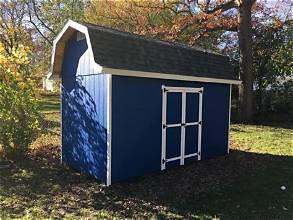
So I went looking. I was surprised at how much had changed. The sheds I remembered from childhood were all thin boards and felt roofs, but the ones I found now had thicker, pressure-treated cladding, proper tongue-and-groove joints, and floors that did not look as though they would go the same way his had. I spent a couple of evenings comparing sizes and window positions online, eventually settling on one from Dobbies that was a little larger than his, with the window on the same side, looking out over the same bit of garden he used to watch while he worked.
Building It Together
My mother came over to help on the day it went up. She had not been in the garden much since he died. We laid the new base first, properly, on a raised frame so the floor would never sit in the wet the way his had. Then we put up the walls, one panel at a time, arguing mildly about which way round the instructions meant.
At some point she picked up a hammer, and I took a photograph of her holding it, squinting at me, with the half-built shed behind her. Neither of us said anything about the other photograph. We did not need to.
What Carries Over
The new shed does not smell of creosote, and the door does not stick. The radio is digital now and cannot get the cricket in winter either. But the coffee jars are back, nailed to the underside of the shelf, and the chisels are in their canvas roll, and his brush is in a jam jar on the windowsill, waiting for the first coat of paint next spring.
I treat the timber the way he did, every year, without fail. Partly because it is the right thing to do for the building. Partly because it gives me an afternoon every spring to stand where he stood and do what he did.
Buildings wear out. That is not the sad part. The sad part would be letting the habit of going out there, closing the door, and quietly getting on with something, wear out with them. This one should see me through a good few decades. I intend to use every one of them.
